Vessel
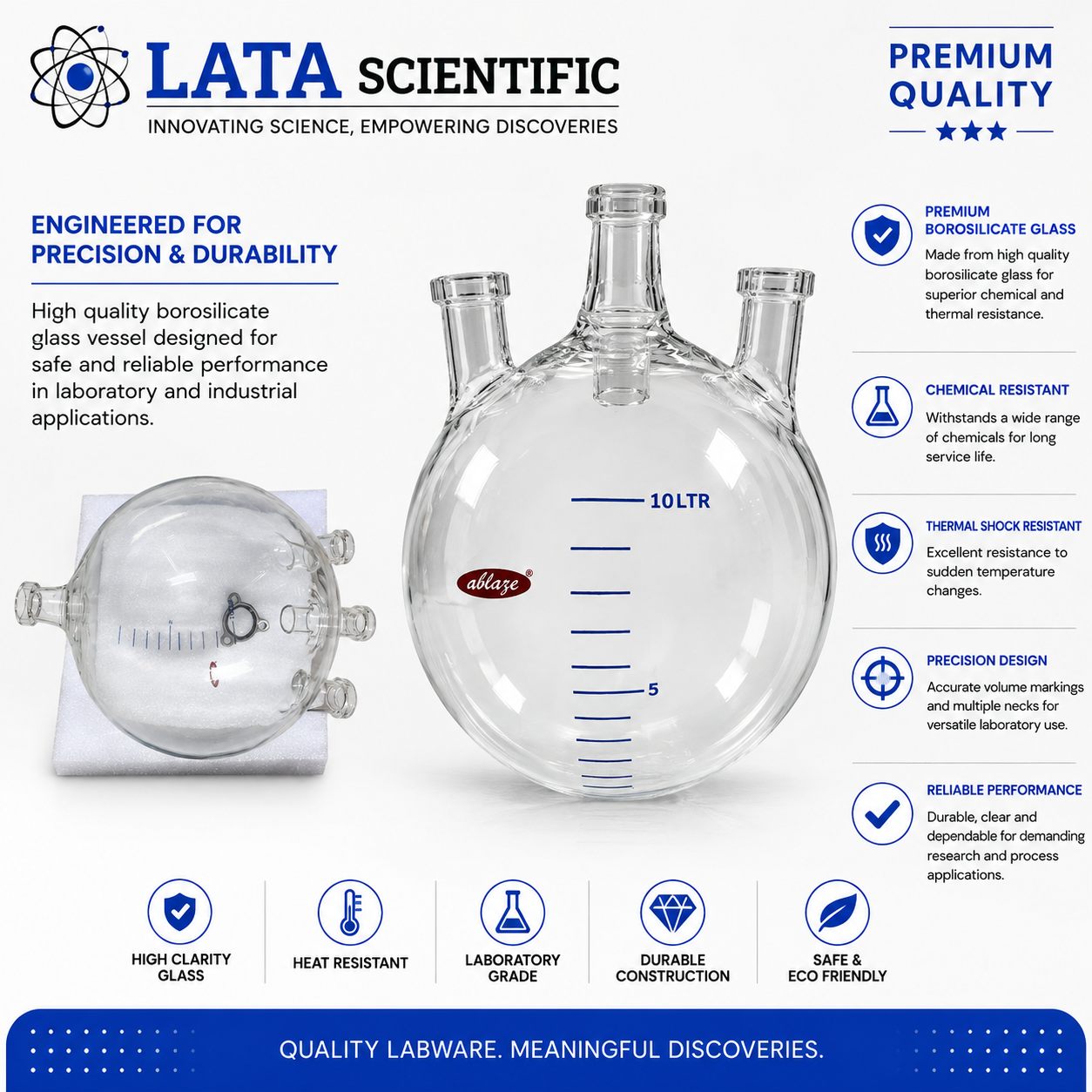
Borosilicate spherical vessel, 5 L to 200 L
Borosilicate spherical vessel from 5 to 200 litres, in a single neck build and a three neck build with bottom outlet — for reaction, receiving and storage duty on a glass plant.
| Product type | Borosilicate spherical vessel |
|---|---|
| Material | Borosilicate 3.3 |
| Nominal capacity range | 5 L to 200 L in six sizes |
| Working capacity range | 4 L to 200 L — see the general data table |
| Maximum pressure | 1.0 bar at 5 L, falling to 0.2 bar at 200 L |
| Builds | Single neck (AVSA series); three neck with bottom outlet (AVSM series) |
| Neck size range | DN 40 to DN 225, capacity dependent |
| Side neck / outlet sizes | DN 25 or DN 40 on the AVSM build, capacity dependent |
Product overview
The sphere is the strongest shape glass can be blown into, and it is why the vessels in this range hold more pressure for their wall thickness than any cylindrical equivalent. There is no corner to concentrate stress and no flat end to bow, so the load spreads evenly through the whole wall. That is also why the catalogue's maximum pressure figure falls as the vessels get bigger — the same wall has to carry a much larger sphere.
Two builds are listed. The single neck vessel (AVSA series) is the simpler item: one top connection, used as a receiver, a feed vessel or a storage bulb. The three neck with bottom outlet vessel (AVSM series) is the process build — a large centre neck for the main connection, two smaller necks for a charge line, a thermometer pocket, a reflux return or an instrument, and a bottom outlet to empty the vessel completely rather than pumping it out through the top.
Read the general data table before the dimension tables. Nominal capacity is the range name, but bulb capacity and working capacity are the figures that matter in practice: a 50 L vessel has a 62 L bulb and 58 L of working volume, and a 200 L vessel works at exactly 200 L against a 212 L bulb. Size the vessel on working capacity and confirm the pressure figure for that size against your duty.
Both builds share the same six nominal sizes — 5, 10, 20, 50, 100 and 200 litres — so the general data applies to either. What changes between them is overall height L and the neck arrangement: the AVSM build is taller at every size because the bottom outlet adds to the overall height.
Features
Benefits
Applications & industries
Technical data
Figures below are for this product only — every item in the range carries its own dimension table.
| Product type | Borosilicate spherical vessel |
|---|---|
| Material | Borosilicate 3.3 |
| Nominal capacity range | 5 L to 200 L in six sizes |
| Working capacity range | 4 L to 200 L — see the general data table |
| Maximum pressure | 1.0 bar at 5 L, falling to 0.2 bar at 200 L |
| Builds | Single neck (AVSA series); three neck with bottom outlet (AVSM series) |
| Neck size range | DN 40 to DN 225, capacity dependent |
| Side neck / outlet sizes | DN 25 or DN 40 on the AVSM build, capacity dependent |
| Overall height | 300 mm to 1000 mm single neck; 425 mm to 1175 mm three neck |
| End connection | Beaded glass ends with backing flanges and PTFE-envelope gaskets |
| Flange drilling | See the drilling table — BS 10 Table E, BS 10 Table F and ASA drilling available |
| Temperature rating | Not published on the catalogue page — confirm with us for your duty |
| Catalogue reference | AVSA series (single neck), AVSM series (three neck & bottom outlet) |
| Cat. Ref. | Nominal Capacity | L | DN |
|---|---|---|---|
| AVSA5 | 5 L | 300 | 40 |
| AVSA10 | 10 L | 375 | 40 |
| AVSA20 | 20 L | 450 | 80 |
| AVSA50 | 50 L | 650 | 100 |
| AVSA100 | 100 L | 750 | 150 |
| AVSA200 | 200 L | 1000 | 225 |
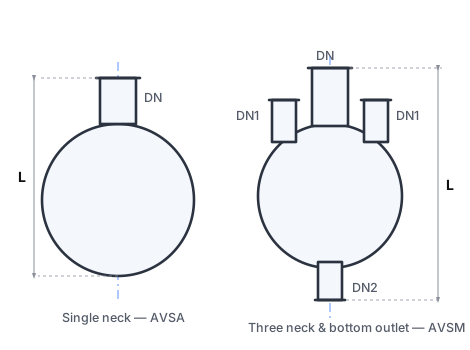
All dimensions in mm, transcribed exactly from the catalogue page. L is the overall height and DN the single top neck. The left-hand view on the drawing is this build.
| Cat. Ref. | Nominal Capacity | L | DN | DN1 | DN2 |
|---|---|---|---|---|---|
| AVSM5 | 5 L | 425 | 40 | 25 | 25 |
| AVSM10 | 10 L | 500 | 40 | 25 | 25 |
| AVSM20 | 20 L | 575 | 80 | 25 | 25 |
| AVSM50 | 50 L | 825 | 100 | 40 | 40 |
| AVSM100 | 100 L | 925 | 150 | 40 | 40 |
| AVSM200 | 200 L | 1175 | 225 | 40 | 40 |
All dimensions in mm, transcribed exactly from the catalogue page. L is the overall height and DN the centre neck. DN1 and DN2 are the smaller connections, and the catalogue prints them with identical values on every row — 25 mm up to 20 L and 40 mm from 50 L up. The right-hand view on the drawing shows the arrangement; state which connection you need each size on when ordering. This build is taller than the single neck vessel at every capacity because the bottom outlet adds to the overall height.
FAQ
Nominal capacity is the size the vessel is sold as. Bulb capacity is the volume the sphere actually holds, and working capacity is what you can use — 58 L on a 50 L vessel, 111 L on a 100 L. All three are printed in the general data table on the category page. Size on working capacity.
Because the same wall has to carry a much larger sphere. The catalogue publishes 1.0 bar at 5 L and 0.2 bar at 200 L, and every size in between. Check the figure for your size against your duty before ordering.
The single neck AVSA build is a receiver, feed or storage vessel. The three neck AVSM build is the process build — centre neck for the main connection, two smaller necks for charging, instrumentation or reflux, and a bottom outlet to drain it. If you need to empty the vessel completely, you need the bottom outlet.
Yes — the Bottom Outlet Valve in the Glass Valves range is made for exactly this. The catalogue notes it can be incorporated in any spherical or cylindrical vessel, and it seats at the vessel floor so nothing accumulates in the outlet.
The catalogue page for this range is dimensional apart from the pressure column, and publishes no temperature figure, so we do not quote one. Send us your duty and we will confirm it against the drawing.
Related products
Enquiry
Send the bore, the media, the temperature and pressure, and the flange standard you work to. Drawings and custom sizes welcome.
Send your requirement — media, temperature, pressure, dimensions — and we'll recommend the right product or fabricate it.
Talk to an engineer