Vessel
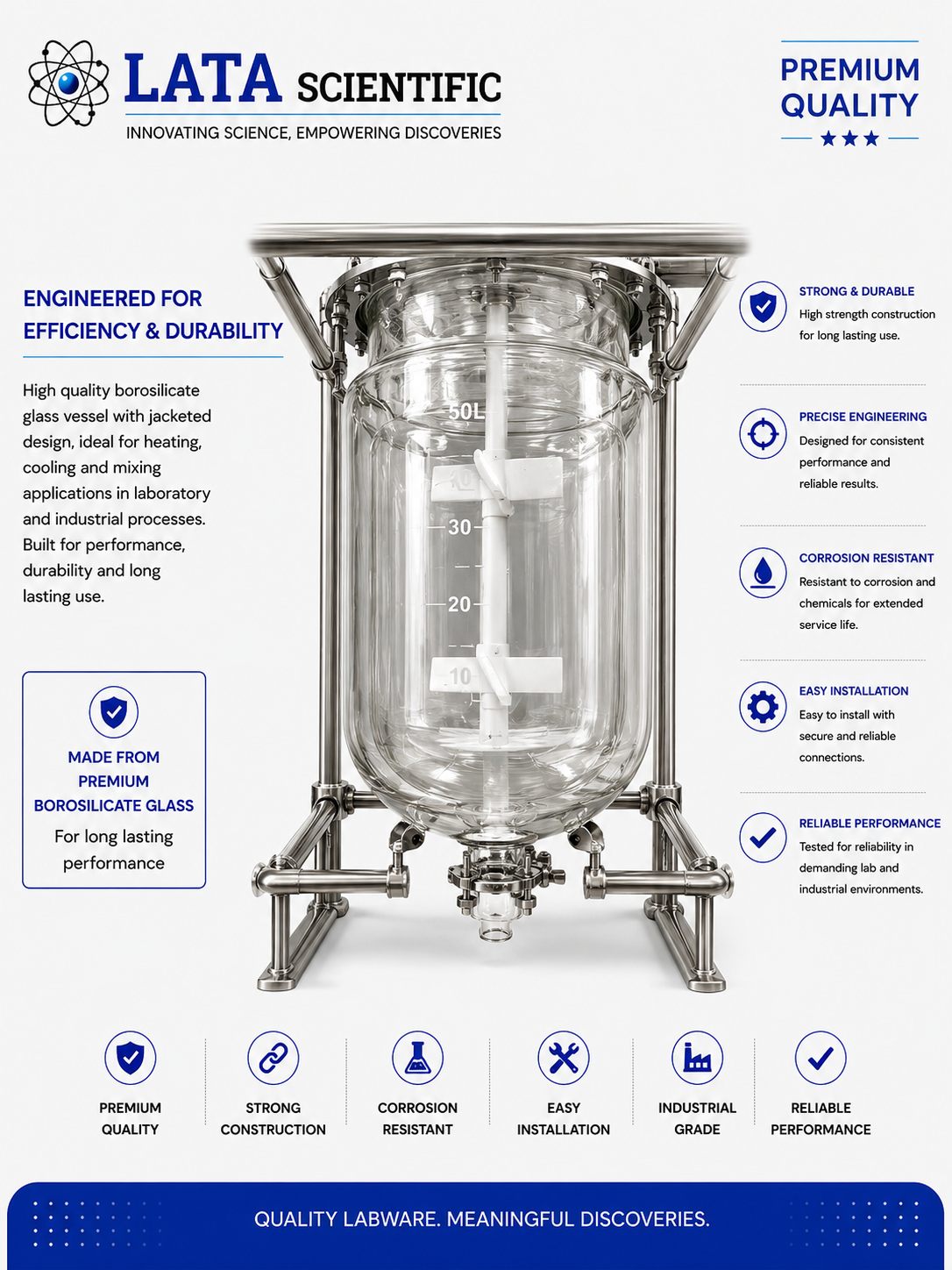
Triple wall jacketed glass vessel for heating, cooling and mixing
Triple wall jacketed borosilicate glass vessel — an inner process chamber, an intermediate jacket for the heat transfer fluid and an outer insulating wall, for heating, cooling and mixing duty in laboratory and industrial processes.
| Product type | Triple wall jacketed glass vessel |
|---|---|
| Material | Borosilicate 3.3 |
| Wall construction | Three concentric walls — inner process chamber, intermediate heat transfer jacket, outer insulating annulus |
| Duty | Heating, cooling and mixing |
| Unit shown | Graduated to 50 litres, with bolted top flange, stirrer shaft, bottom outlet valve and stainless steel support frame |
| Capacity | Built to order — tell us your working volume |
| Jacket service connections | Confirm with us for your circulator and heat transfer fluid |
| Pressure rating | Not published for this item — confirm with us for your duty |
Product overview
A jacketed vessel is how a process gets held at temperature. Heat transfer fluid circulates in a jacket around the process chamber, so the batch is heated or cooled through the vessel wall itself rather than by an external bath — the whole charge sees the same wall temperature, and the rate is set by the fluid, not by how the vessel happens to be sitting.
The triple wall build adds a third, outer wall around that jacket. The annulus between the jacket and the outer wall is the insulation: it cuts the heat the jacket loses to the room, so the circulator holds temperature with less work and the process stays stable. It also keeps the outside of the vessel closer to room temperature — which on cold duty is what stops the outer surface fogging or frosting over and hiding the batch from the operator.
That is the practical argument for the third wall. A twin wall jacketed vessel run at low temperature ices up and you lose the one thing glass was chosen for: being able to see what is happening. A triple wall vessel stays clear.
In the supplier's own words, this is a high quality borosilicate glass vessel with jacketed design, ideal for heating, cooling and mixing applications in laboratory and industrial processes, built for performance, durability and long lasting use. The unit shown is graduated to 50 litres and is supplied complete with its bolted top flange and nozzles, stirrer shaft and impellers, a bottom outlet valve and a stainless steel support frame.
Features
Benefits
Applications & industries
Technical data
Figures below are for this product only — every item in the range carries its own dimension table.
| Product type | Triple wall jacketed glass vessel |
|---|---|
| Material | Borosilicate 3.3 |
| Wall construction | Three concentric walls — inner process chamber, intermediate heat transfer jacket, outer insulating annulus |
| Duty | Heating, cooling and mixing |
| Unit shown | Graduated to 50 litres, with bolted top flange, stirrer shaft, bottom outlet valve and stainless steel support frame |
| Capacity | Built to order — tell us your working volume |
| Jacket service connections | Confirm with us for your circulator and heat transfer fluid |
| Pressure rating | Not published for this item — confirm with us for your duty |
| Temperature rating | Not published for this item — confirm with us for your duty |
| Dimensions | Supplied on the general arrangement drawing for your capacity — request it with your enquiry |
FAQ
It insulates. The annulus between the jacket and the outer wall cuts the heat the jacket loses to the room, so the circulator holds temperature with less work — and it keeps the outer surface near room temperature, which is what stops the vessel fogging or frosting over on cold duty.
For ambient and warm duty, you often can. The triple wall earns its place at low temperature: a twin wall vessel ices up on the outside and you lose visibility of the batch, which is usually the reason glass was specified in the first place.
It is built to order. The unit shown is graduated to 50 litres; tell us your working volume and duty and we will confirm the build.
Dimensions come on the general arrangement drawing for your capacity rather than from a standard table, because the vessel is made to order. Send us your requirement and we will issue the drawing with the quotation.
The unit shown is supplied complete with its stainless steel support frame, stirrer shaft and impellers, bolted top flange and bottom outlet valve. Tell us what agitation and instrumentation you need and we will quote the assembly.
Related products
Enquiry
Send the bore, the media, the temperature and pressure, and the flange standard you work to. Drawings and custom sizes welcome.
Send your requirement — media, temperature, pressure, dimensions — and we'll recommend the right product or fabricate it.
Talk to an engineer