Pilot Plant Series
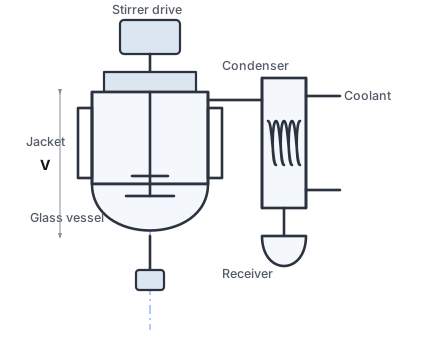
See-through pilot plant reactor, 15 L to 250 L
Pilot plant reaction assembly with a see-through borosilicate glass or glass lined steel vessel — 15 L to 250 L, −25 °C to +200 °C, full vacuum to +0.5 bar.
| Product type | Pilot plant chemical reactor assembly |
|---|---|
| Volume | 15 to 250 litres |
| Temperature | −25 °C to +200 °C |
| Pressure | +0.5 bar to full vacuum |
| Wetted material | Borosilicate glass; glass lined steel for higher capacity |
| Vessel options | Cylindrical or spherical; auto control available |
| Agitation | Lower to higher Reynolds mixing — anchor type, tubular type, propeller type and others, selected for the duty |
| Heating and cooling | Heating mantles, oil bath, thermic fluid, steam or hot condensate through a glass jacket or glass coils |
Product overview
Ablaze pilot plant reactors are equipped with see-through reaction vessels made of borosilicate glass or glass lined steel. Contrary to conventional reaction vessels, the glass used for the upper section enables the chemist to observe the process taking place inside. It also prevents residues from adhering on to the smooth, unheated glass surface.
The reactor is supplied as a working assembly rather than a bare vessel. Stirrer, condenser, reflux divider and feed arrangement are fitted as the duty requires, and further attachments are available for distillation. Instrumentation — pH controller, temperature controller and a speed regulator for the stirrer — is part of the same single-window supply.
The vision behind the LSPPS range is to provide a single window source for all equipment and instrumentation of the highest quality, for research and development as well as for pilot plants. The range is also available in spherical vessel options and with auto control.
Features
Benefits
Applications & industries
Technical data
Figures below are for this product only — every item in the range carries its own dimension table.
| Product type | Pilot plant chemical reactor assembly |
|---|---|
| Volume | 15 to 250 litres |
| Temperature | −25 °C to +200 °C |
| Pressure | +0.5 bar to full vacuum |
| Wetted material | Borosilicate glass; glass lined steel for higher capacity |
| Vessel options | Cylindrical or spherical; auto control available |
| Agitation | Lower to higher Reynolds mixing — anchor type, tubular type, propeller type and others, selected for the duty |
| Heating and cooling | Heating mantles, oil bath, thermic fluid, steam or hot condensate through a glass jacket or glass coils |
| Instrumentation | pH controller, temperature controller, stirrer speed regulator |
| Attachments | Stirrer, condenser, reflux divider, feed arrangement; distillation attachments available |
| Catalogue reference | LSPPS Chemical Reactor |
| Volume | Temp | Pressure | Wetted Material |
|---|---|---|---|
| 15 to 250 Ltrs. | −25 to +200 °C | +0.5 bar to Full Vacuum | glass / glass lined steel for higher capacity |
Transcribed exactly from the catalogue table. The page adds that this is also available in spherical options and with auto control.
FAQ
Two reasons the catalogue gives directly: the chemist can observe the process taking place inside, and residues do not adhere to the smooth, unheated glass surface the way they do to a heated steel wall.
15 to 250 litres. Borosilicate glass is used for the vessel, with glass lined steel offered for the higher capacities in the range.
+0.5 bar down to full vacuum, over −25 °C to +200 °C. If you need to react at higher pressure, that is the LSPPS High Pressure Reactor in Glass instead — or a metal reactor for very high pressure.
Whichever suits the mixing regime. The range covers lower to higher Reynolds mixing with anchor, tubular and propeller types among others — tell us the viscosity and the duty.
Through heating mantles, oil bath, thermic fluid, steam or hot condensate passed through a glass jacket or glass coils.
Related products
Enquiry
Send the bore, the media, the temperature and pressure, and the flange standard you work to. Drawings and custom sizes welcome.
Send your requirement — media, temperature, pressure, dimensions — and we'll recommend the right product or fabricate it.
Talk to an engineer