Pilot Plant Series

RGG / RMG series, 3 m² to 25 m²
Shell and tube heat exchanger in twelve models from 3 m² to 25 m² across 150, 225 and 300 DN shells — 14 mm tubes, with nozzles changed to the client's requirement.
| Product type | Shell and tube heat exchanger |
|---|---|
| Model range | RGG/RMG 6/3 to 12/25 — twelve models |
| Heat transfer area | 3 m² to 25 m² |
| Shell sizes | 150 DN (6"), 225 DN (9") and 300 DN (12") |
| Number of tubes | 37 (150 DN), 73 (225 DN), 151 (300 DN) |
| Tube diameter | 14 mm |
| Number of baffles | 5 to 23, depending on model |
| Overall length | 2500 mm to 4550 mm |
Product overview
The glass shell and tube heat exchanger is a recent development in the range. It can be used for condensation of vapours, vapourisation, and cooling and heating of liquid, and it is available in various combinations of glass, metal and FRP in the shell or the tube. Process fluid passes through a bundle of tubes while the service fluid circulates in the shell around them, with baffles directing the shell-side flow across the bundle instead of straight along it.
The range covers twelve models on three shell sizes. A 150 DN (6") shell carries 37 tubes and gives 3 to 6 m²; a 225 DN (9") shell carries 73 tubes for 6 to 12 m²; a 300 DN (12") shell carries 151 tubes for 12 to 25 m². Within each shell, area is increased by lengthening the exchanger rather than widening it — which is why L runs from 2500 mm at the smallest model to 4550 mm at the largest.
The catalogue reference reads directly as shell size over area: RGG/RMG 9/12 is a 9-inch shell with 12 m² of heat transfer area. Tube diameter is 14 mm throughout, and the baffle count rises with length so shell-side velocity is maintained as the exchanger gets longer.
Features
Benefits
Applications & industries
Technical data
Figures below are for this product only — every item in the range carries its own dimension table.
| Product type | Shell and tube heat exchanger |
|---|---|
| Model range | RGG/RMG 6/3 to 12/25 — twelve models |
| Heat transfer area | 3 m² to 25 m² |
| Shell sizes | 150 DN (6"), 225 DN (9") and 300 DN (12") |
| Number of tubes | 37 (150 DN), 73 (225 DN), 151 (300 DN) |
| Tube diameter | 14 mm |
| Number of baffles | 5 to 23, depending on model |
| Overall length | 2500 mm to 4550 mm |
| Nozzles | DN1 to DN4; can be changed as per client's requirement |
| Catalogue reference | RGG / RMG series — shell inch / area m² |
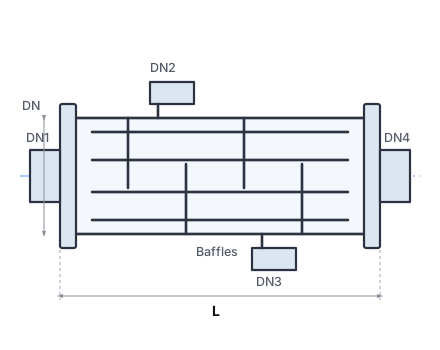
| Cat. Ref. (RGG/RMG) | Area (m²) | DN | DN1 | DN2 | DN3 | DN4 | H1 | H2 | L | L1 | L2 | L3 | C | C1 | C2 | T | E | No. of tubes | No. of baffles |
|---|---|---|---|---|---|---|---|---|---|---|---|---|---|---|---|---|---|---|---|
| 6/3 | 3 | 150 | 80 | 50 | 25 | 50 | 175 | 125 | 2500 | 1900 | 1600 | 1990 | 250 | 125 | 125 | 300 | 50 | 37 | 11 |
| 6/4 | 4 | 150 | 80 | 50 | 25 | 50 | 175 | 125 | 3100 | 2500 | 2200 | 2590 | 250 | 125 | 125 | 300 | 50 | 37 | 15 |
| 6/5 | 5 | 150 | 80 | 50 | 25 | 50 | 175 | 125 | 3700 | 3100 | 2800 | 3190 | 250 | 125 | 125 | 300 | 50 | 37 | 19 |
| 6/6 | 6 | 150 | 80 | 50 | 25 | 50 | 175 | 125 | 4300 | 3700 | 3400 | 3790 | 250 | 125 | 125 | 300 | 50 | 37 | 23 |
| 9/6 | 6 | 225 | 100 | 50 | 40 | 50 | 250 | 200 | 2620 | 1900 | 1450 | 2000 | 300 | 175 | 125 | 450 | 60 | 73 | 7 |
| 9/8 | 8 | 225 | 100 | 50 | 40 | 50 | 250 | 200 | 3220 | 2500 | 2050 | 2600 | 300 | 175 | 125 | 450 | 60 | 73 | 9 |
| 9/10 | 10 | 225 | 100 | 50 | 40 | 50 | 250 | 200 | 3820 | 3100 | 2650 | 3200 | 300 | 175 | 125 | 450 | 60 | 73 | 13 |
| 9/12 | 12 | 225 | 100 | 50 | 40 | 50 | 250 | 200 | 4520 | 3800 | 3350 | 3900 | 300 | 175 | 125 | 450 | 60 | 73 | 17 |
| 12/12 | 12 | 300 | 150 | 80 | 40 | 50 | 300 | 250 | 2550 | 1800 | 1350 | 1930 | 300 | 225 | 75 | 450 | 75 | 151 | 5 |
| 12/16 | 16 | 300 | 150 | 80 | 40 | 50 | 300 | 250 | 3150 | 2400 | 1950 | 2530 | 300 | 225 | 75 | 450 | 75 | 151 | 7 |
| 12/21 | 21 | 300 | 150 | 80 | 40 | 50 | 300 | 250 | 3950 | 3200 | 2750 | 3330 | 300 | 225 | 75 | 450 | 75 | 151 | 9 |
| 12/25 | 25 | 300 | 150 | 80 | 40 | 50 | 300 | 250 | 4550 | 3800 | 3350 | 3930 | 300 | 225 | 75 | 450 | 75 | 151 | 11 |
All dimensions in mm, transcribed from the catalogue page and transposed to one row per model. The catalogue prints this table with one column per model; it is transposed here to one row per model, with no value altered. Two notes are printed on the page and apply to every model: tube diameter is 14 mm, and nozzles can be changed as per client's requirement. DN, DN1 to DN4, H1, H2, C, C1, C2, T, E, the tube count and the shell size are constant within each shell group; L, L1, L2, L3 and the baffle count vary by model.
| Shell size | Tubes | Plugs | Bushes | “O” rings | Key |
|---|---|---|---|---|---|
| DN 150 | 5 | 4 | 4 | 4 | 1 |
| DN 225 | 10 | 6 | 6 | 6 | 1 |
| DN 300 | 15 | 8 | 8 | 8 | 1 |
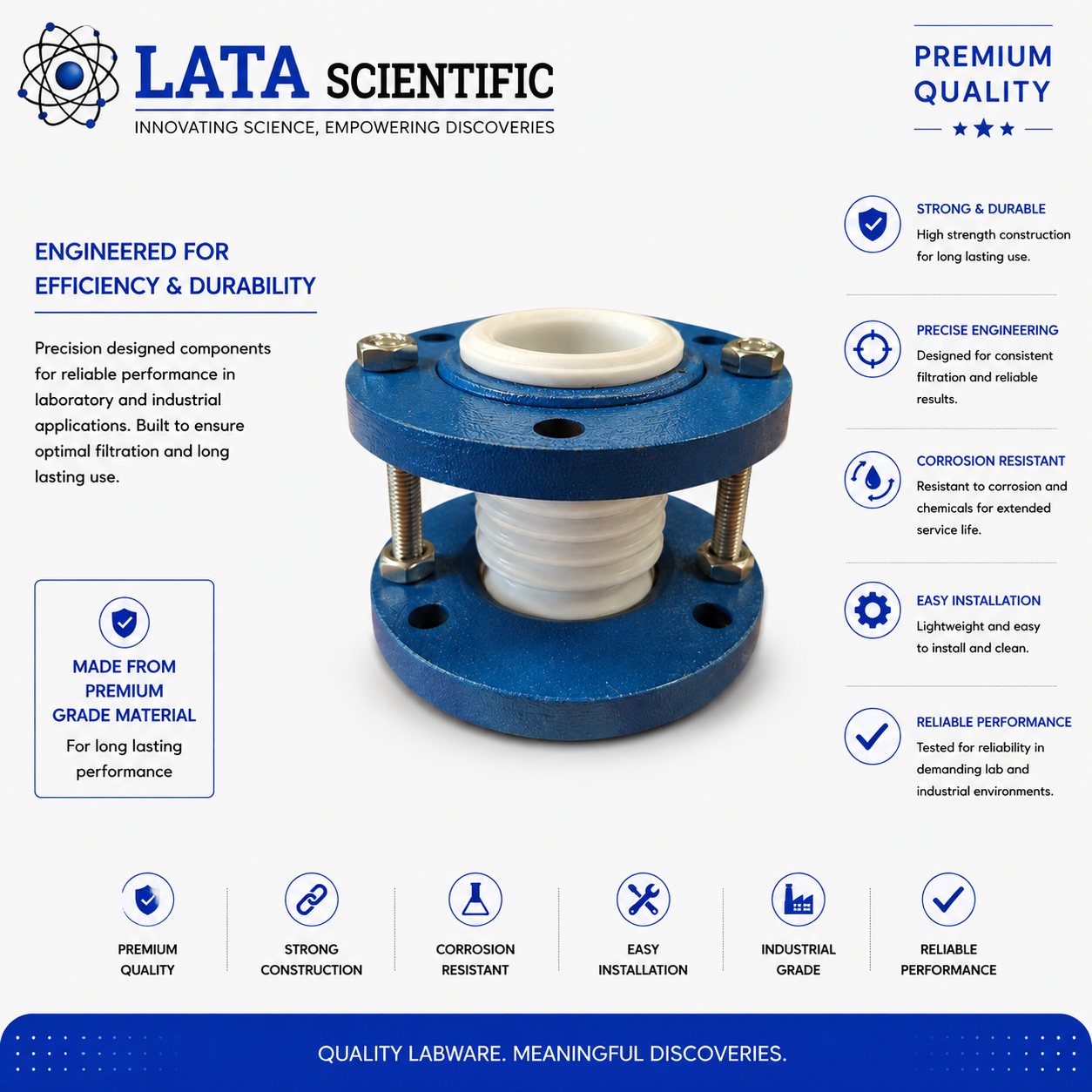
The heat exchanger is supplied with these spares as standard, transcribed from the catalogue page. Three accessories are recommended for use with it: a PTFE bellow on all nozzles, a pressure relief valve, and a supporting clamp.
FAQ
Shell size in inches over heat transfer area in m². RGG/RMG 9/12 is a 9-inch (225 DN) shell with 12 m² of area. 12/25 is a 12-inch (300 DN) shell with 25 m².
14 mm across the whole range — the catalogue states it as a note on the table rather than as a per-model column.
Yes. The catalogue states directly that nozzles can be changed as per client's requirement. The DN1 to DN4 figures in the table are the standard arrangement.
Because they are available on two different shells. 6 m² comes as 6/6 on a 150 DN shell or 9/6 on a 225 DN shell; 12 m² comes as 9/12 or 12/12. Same area, different shell diameter, different shell-side velocity and pressure drop — pick on the hydraulics, not the area.
By length. The tube count is fixed by the shell — 37, 73 or 151 — so more area means a longer exchanger. L runs from 2500 mm to 4300 mm inside the 150 DN shell alone, and the baffle count rises with it to keep shell-side velocity up.
Related products


Enquiry
Send the bore, the media, the temperature and pressure, and the flange standard you work to. Drawings and custom sizes welcome.
Send your requirement — media, temperature, pressure, dimensions — and we'll recommend the right product or fabricate it.
Talk to an engineer