Pipe Section
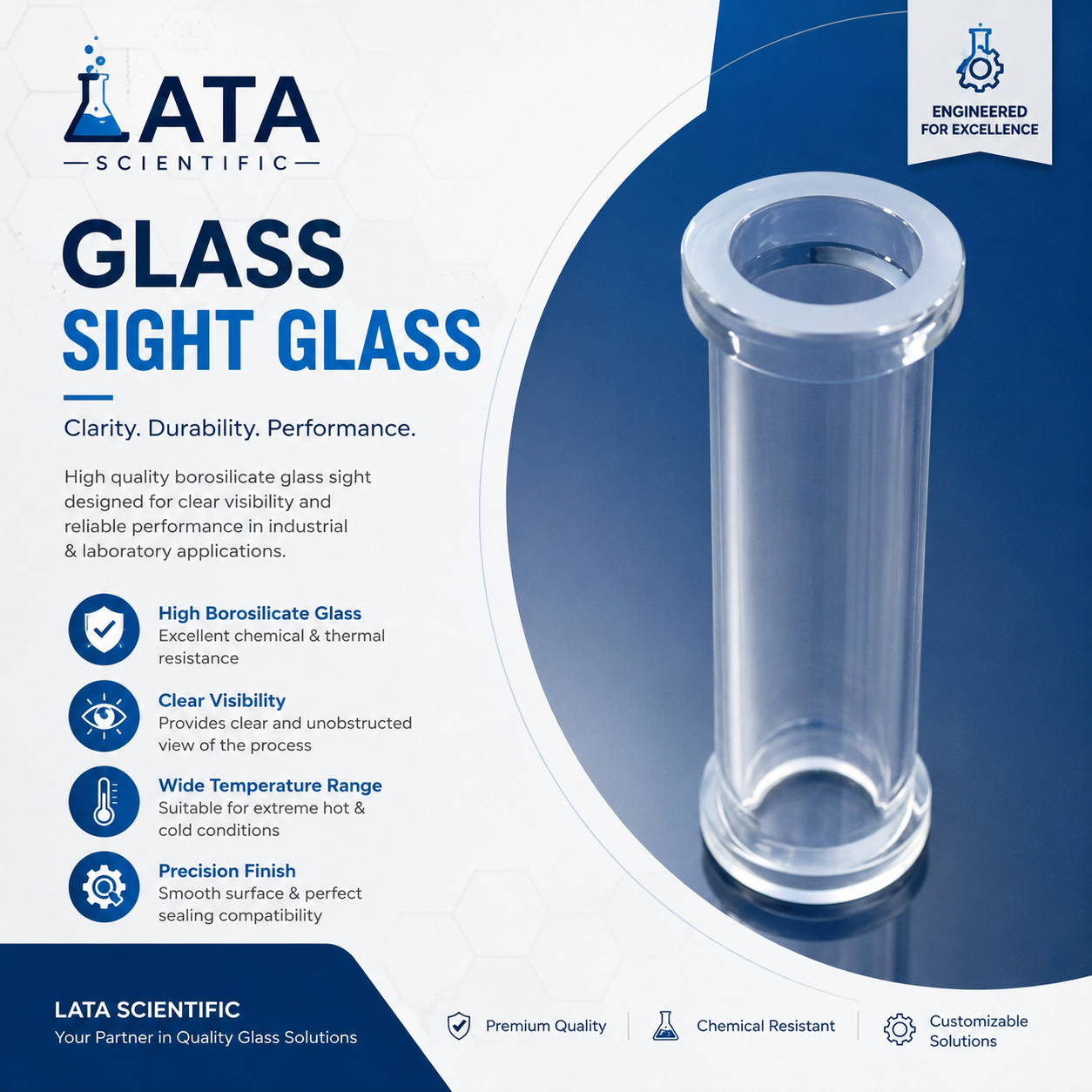
Straight glass pipe section, DN 15 to DN 600
Straight borosilicate glass pipe section — the run element of a glass pipeline, DN 15 to DN 600 in standard lengths from 100 mm to 1500 mm.
| Product type | Straight glass pipe section |
|---|---|
| Material | Borosilicate 3.3 |
| Nominal bore range | DN 15 to DN 600 |
| End connection | Beaded pipe ends with backing flanges and PTFE-envelope gaskets |
| Flange drilling | See the drilling table — BS 10 Table E, BS 10 Table F and ASA drilling available |
| Pressure rating | Not published on the component datasheet — confirm with us for your duty |
| Temperature rating | Not published on the component datasheet — confirm with us for your duty |
| Dimensional standard | As per the Lata Scientific component datasheet |
Product overview
The pipe section is the building block of a glass process line. Borosilicate 3.3 gives it near-universal chemical resistance and full visibility of the product, while beaded ends and backing flanges let a line be assembled, extended or reconfigured without cutting or welding anything.
The datasheet lists standard lengths against each nominal bore, and every combination carries its own catalogue reference — for example LSPS1/500 is a DN 25 section 500 mm long. Bores from DN 15 to DN 600 are covered, with lengths to 1000 mm on the smaller bores and 1500 mm from DN 225 upward.
Features
Benefits
Applications & industries
Technical data
Figures below are for this product only — every item in the range carries its own dimension table.
| Product type | Straight glass pipe section |
|---|---|
| Material | Borosilicate 3.3 |
| Nominal bore range | DN 15 to DN 600 |
| End connection | Beaded pipe ends with backing flanges and PTFE-envelope gaskets |
| Flange drilling | See the drilling table — BS 10 Table E, BS 10 Table F and ASA drilling available |
| Pressure rating | Not published on the component datasheet — confirm with us for your duty |
| Temperature rating | Not published on the component datasheet — confirm with us for your duty |
| Dimensional standard | As per the Lata Scientific component datasheet |
| Catalogue reference | LSPS series, e.g. LSPS1/500 = DN 25 × 500 mm |
| Standard lengths | 100, 150, 200, 250, 300, 400, 500, 600, 750, 900, 1000, 1200, 1500 mm — bore dependent |
| Length L | DN 15 | DN 25 | DN 40 | DN 50 | DN 80 | DN 100 | DN 150 | DN 225 | DN 300 | DN 400 | DN 450 | DN 600 |
|---|---|---|---|---|---|---|---|---|---|---|---|---|
| 100 | LSPS07/100 | LSPS1/100 | LSPS1.5/100 | LSPS2/100 | — | — | — | — | — | — | — | — |
| 150 | LSPS07/150 | LSPS1/150 | LSPS1.5/150 | LSPS2/150 | LSPS3/150 | LSPS4/150 | LSPS6/150 | — | — | — | — | — |
| 200 | LSPS07/200 | LSPS1/200 | LSPS1.5/200 | LSPS2/200 | LSPS3/200 | LSPS4/200 | LSPS6/200 | — | — | — | — | — |
| 250 | LSPS07/250 | LSPS1/250 | LSPS1.5/250 | LSPS2/250 | LSPS3/250 | LSPS4/250 | LSPS6/250 | — | — | — | — | — |
| 300 | LSPS07/300 | LSPS1/300 | LSPS1.5/300 | LSPS2/300 | LSPS3/300 | LSPS4/300 | LSPS6/300 | LSPS9/300 | LSPS12/300 | LSPS16/300 | LSPS18/300 | LSPS24/300 |
| 400 | LSPS07/400 | LSPS1/400 | LSPS1.5/400 | LSPS2/400 | LSPS3/400 | LSPS4/400 | LSPS6/400 | LSPS9/400 | LSPS12/400 | — | — | — |
| 500 | LSPS07/500 | LSPS1/500 | LSPS1.5/500 | LSPS2/500 | LSPS3/500 | LSPS4/500 | LSPS6/500 | LSPS9/500 | LSPS12/500 | LSPS16/500 | LSPS18/500 | LSPS24/500 |
| 600 | LSPS07/600 | LSPS1/600 | LSPS1.5/600 | LSPS2/600 | LSPS3/600 | LSPS4/600 | LSPS6/600 | LSPS9/600 | LSPS12/600 | — | — | — |
| 750 | LSPS07/750 | LSPS1/750 | LSPS1.5/750 | LSPS2/750 | LSPS3/750 | LSPS4/750 | LSPS6/750 | LSPS9/750 | LSPS12/750 | LSPS16/750 | LSPS18/750 | LSPS24/750 |
| 900 | LSPS07/900 | LSPS1/900 | LSPS1.5/900 | LSPS2/900 | LSPS3/900 | LSPS4/900 | LSPS6/900 | LSPS9/900 | LSPS12/900 | — | — | — |
| 1000 | LSPS07/1000 | LSPS1/1000 | LSPS1.5/1000 | LSPS2/1000 | LSPS3/1000 | LSPS4/1000 | LSPS6/1000 | LSPS9/1000 | LSPS12/1000 | LSPS16/1000 | LSPS18/1000 | LSPS24/1000 |
| 1200 | — | — | — | — | — | — | — | LSPS9/1200 | LSPS12/1200 | LSPS16/1200 | LSPS18/1200 | LSPS24/1200 |
| 1500 | — | — | — | — | — | — | — | LSPS9/1500 | LSPS12/1500 | LSPS16/1500 | LSPS18/1500 | LSPS24/1500 |
Lengths in mm. The datasheet publishes this range as four separate bore groups; they are combined here into one grid, with “—” where the datasheet lists no reference for that bore and length.
FAQ
LSPS is the pipe-section series, the first number is the bore in inches (07 = 3/4", 1 = 1", 1.5 = 1.1/2", 12 = 12") and the number after the slash is the length in mm. LSPS4/500 is therefore a DN 100 section 500 mm long.
Yes — the table gives the standard stocked lengths. Non-standard lengths are cut to order; send the dimension with your enquiry.
Beaded glass ends clamped by backing flanges onto PTFE-envelope gaskets. Nothing is cut or welded, so a line can be extended or reconfigured later.
Related products
Enquiry
Send the bore, the media, the temperature and pressure, and the flange standard you work to. Drawings and custom sizes welcome.
Send your requirement — media, temperature, pressure, dimensions — and we'll recommend the right product or fabricate it.
Talk to an engineer