PTFE Bellows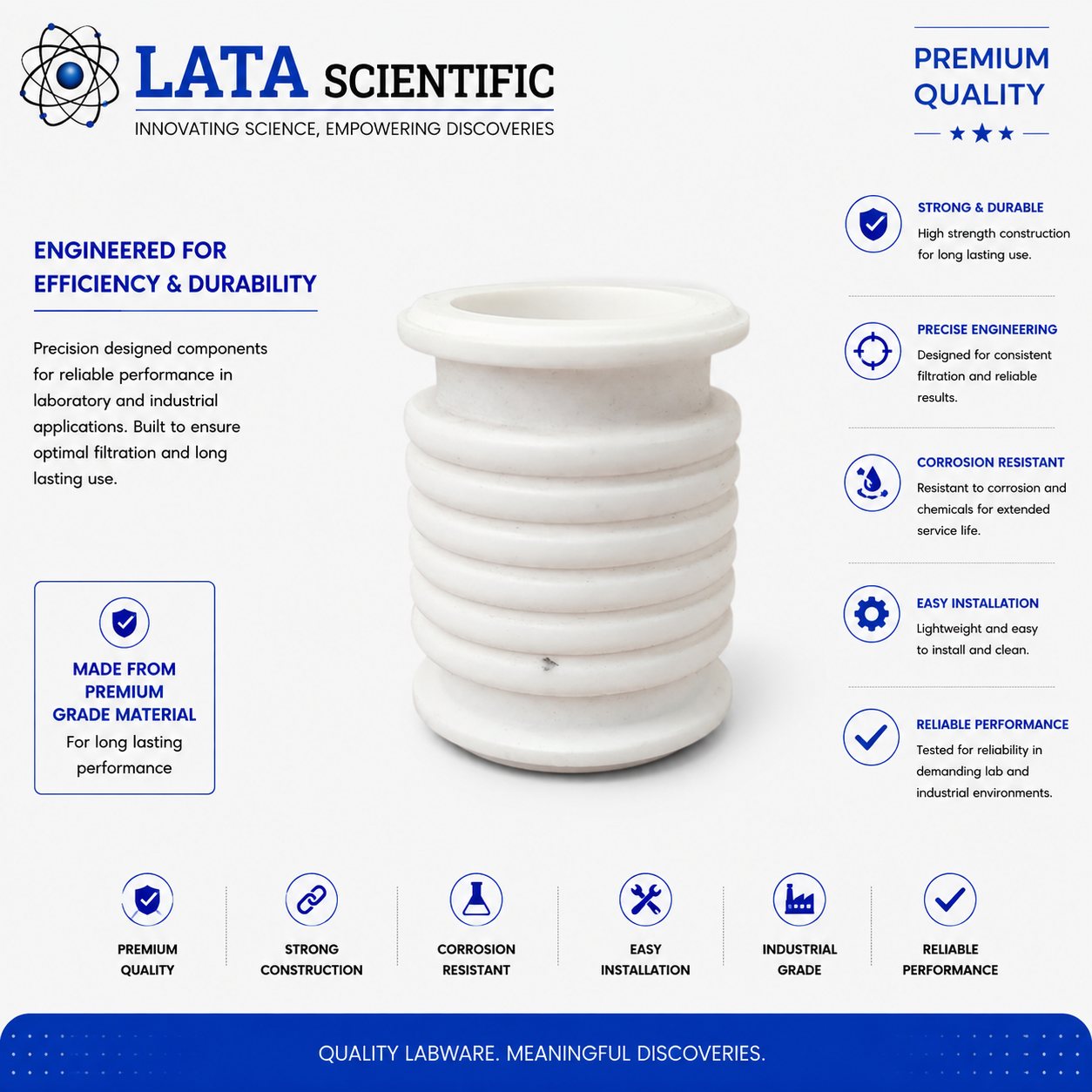
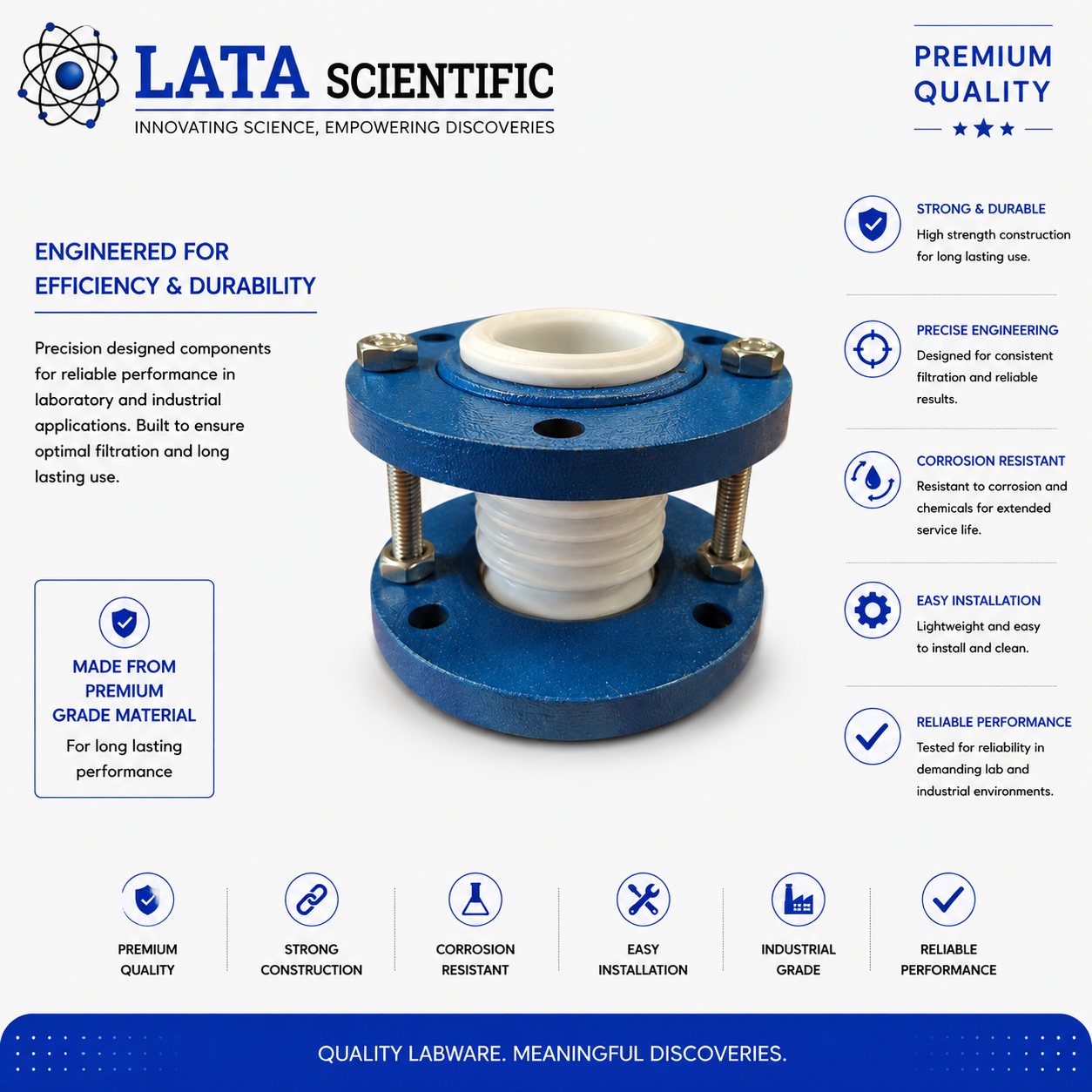
LSFBN series, DN 15 to DN 300
PTFE bellow for joining glass to glass — takes up odd degrees and length variation, branches a pipeline safely, and withstands 200 °C under normal atmospheric conditions.
| Product type | PTFE bellow, glass to glass |
|---|---|
| Material | PTFE |
| Nominal bore range | DN 15 to DN 300 |
| Temperature rating | 200 °C under normal atmospheric conditions |
| Face to face | 65 mm across the range |
| Supply | With required bellow flanges and nut-bolts; distance locking bolts included |
| Gasket | Not required where a bellow is used |
| Flange drilling | Refer to the bellow flange — Table E, Table F and ASA 150 available |
Product overview
This bellow is used in the installation of glass equipment for two purposes the catalogue states directly: to provide safe branching of pipelines from the main glass equipment, and to accommodate odd degrees and variation in length. A glass line that has to be built to a real building rarely lands on exact centres, and the bellow is what absorbs the difference without stressing the glass.
The bellow is supplied along with the required bellow flanges and nut-bolts. Distance locking bolts are provided to avoid excessive compression or contraction of the bellow — the bellow is a flexible element, not an adjustable one, and the locking bolts keep it inside its working range. No gasket is required where a bellow is used.
The line bellow withstands a temperature of 200 °C under normal atmospheric conditions. Where the line runs under vacuum at 80 DN and above, the vacuum bellow with its internal support sleeve should be used instead. For drilling details, refer to the bellow flange.
Features
Benefits
Applications & industries
Technical data
Figures below are for this product only — every item in the range carries its own dimension table.
| Product type | PTFE bellow, glass to glass |
|---|---|
| Material | PTFE |
| Nominal bore range | DN 15 to DN 300 |
| Temperature rating | 200 °C under normal atmospheric conditions |
| Face to face | 65 mm across the range |
| Supply | With required bellow flanges and nut-bolts; distance locking bolts included |
| Gasket | Not required where a bellow is used |
| Flange drilling | Refer to the bellow flange — Table E, Table F and ASA 150 available |
| Catalogue reference | LSFBN series |
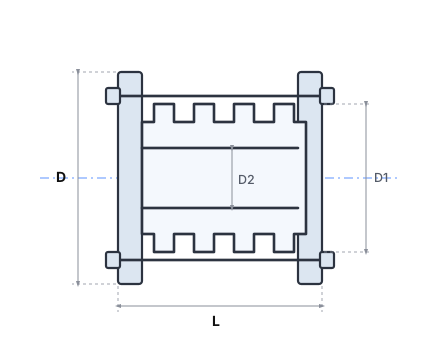
| Cat. Ref. | DN | D | D1 | D2 | L |
|---|---|---|---|---|---|
| LSFBN 07 | 15 | 6 | 28 | 21 | 65 |
| LSFBN 1 | 25 | 95 | 41 | 31 | 65 |
| LSFBN 1.5 | 40 | 105 | 56 | 43 | 65 |
| LSFBN 2 | 50 | 120 | 69 | 55 | 65 |
| LSFBN 3 | 80 | 155 | 98 | 82 | 65 |
| LSFBN 4 | 100 | 200 | 132 | 11 | 65 |
| LSFBN 6 | 150 | 275 | 184 | 162 | 65 |
| LSFBN 9 | 225 | 350 | 258 | 230 | 65 |
| LSFBN 12 | 300 | 420 | 340 | 308 | 65 |
All dimensions in mm, transcribed exactly from the catalogue page. Two cells are reproduced as printed and are plainly misprints: LSFBN 07 shows D as “6” where the rest of that column runs 95 to 420, and LSFBN 4 shows D2 as “11” where its neighbours are 82 and 162. Confirm both with us before manufacture.
FAQ
No. The catalogue states it plainly — a gasket is not required where a bellow is used. The bellow face seals against the glass end itself.
To avoid excessive compression or contraction of the bellow. They cap the travel so the bellow is not pulled or squashed beyond its working range during installation.
200 °C under normal atmospheric conditions. Under vacuum at 80 DN and above, use the vacuum bellow instead — it carries an internal sleeve that supports the convolutions.
On the bellow flange. The bellow itself is dimensioned by DN, D, D1, D2 and L; the flange page carries the PCD and hole pattern.
Related products



Enquiry
Send the bore, the media, the temperature and pressure, and the flange standard you work to. Drawings and custom sizes welcome.
Send your requirement — media, temperature, pressure, dimensions — and we'll recommend the right product or fabricate it.
Talk to an engineer