Flanges, Inserts & Adaptors
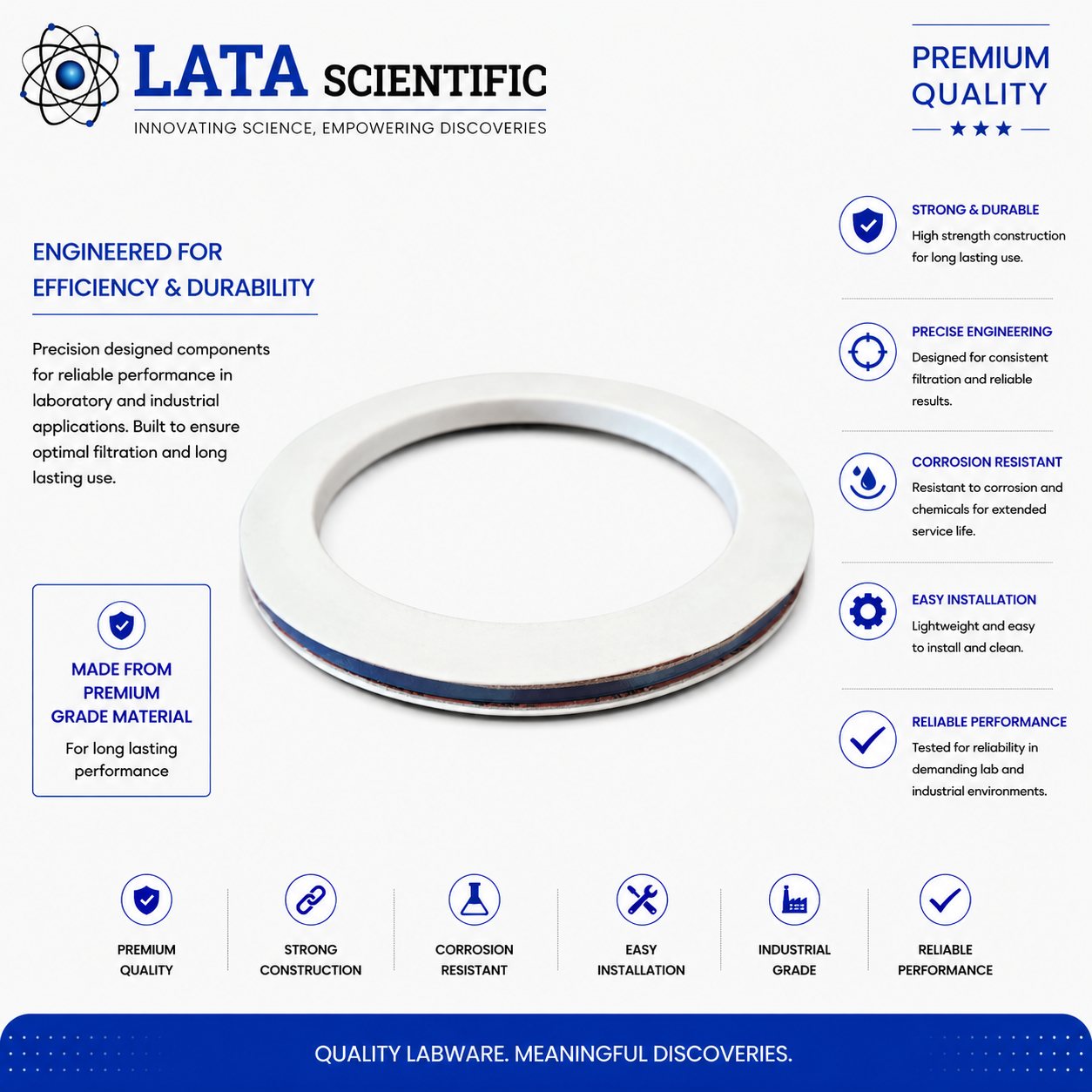
LSEMP series for reactors, DN 25 to DN 300
PTFE-enveloped interface spacer for connecting glass or a bellow to a reactor with a curved end nozzle — only PTFE contacts the process fluid.
| Product type | Glass to metal adaptor plate for reactors |
|---|---|
| Construction | Flat metal ring with rubber cushion, enveloped with PTFE |
| Wetted material | PTFE only |
| Nominal bore range | DN 25 to DN 300 |
| Thickness | 10 mm to 15 mm depending on bore |
| Application | Interface spacer where the reactor has a curved end nozzle |
| Catalogue reference | LSEMP series |
Product overview
When a reactor has a curved end nozzle, this adaptor is used as an interface spacer to connect the glass or the bellow with the reactor. A curved nozzle gives nothing flat for a glass end to seal against, and the adaptor plate provides that face.
It is a flat metal ring with a rubber cushion, enveloped with PTFE, to provide ideal sealing. The metal gives the plate its stiffness, the rubber cushion lets it conform to the curved nozzle, and the PTFE envelope means only PTFE comes into contact with the process fluid.
The range covers DN 25 to DN 300 in eight catalogue references, with plate thickness increasing from 10 mm to 15 mm as bore increases.
Features
Benefits
Applications & industries
Technical data
Figures below are for this product only — every item in the range carries its own dimension table.
| Product type | Glass to metal adaptor plate for reactors |
|---|---|
| Construction | Flat metal ring with rubber cushion, enveloped with PTFE |
| Wetted material | PTFE only |
| Nominal bore range | DN 25 to DN 300 |
| Thickness | 10 mm to 15 mm depending on bore |
| Application | Interface spacer where the reactor has a curved end nozzle |
| Catalogue reference | LSEMP series |
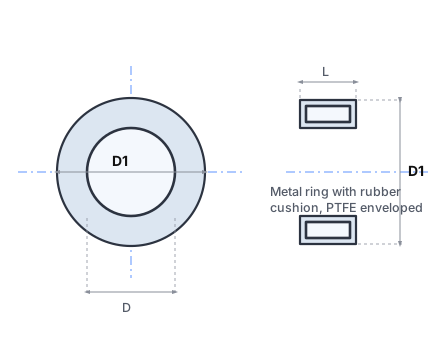
| Cat. Ref. | DN | D | D1 | L |
|---|---|---|---|---|
| LSEMP 1 | 25 | 25 | 60 | 10 |
| LSEMP 1.5 | 40 | 37 | 80 | 10 |
| LSEMP2 | 50 | 50 | 100 | 10 |
| LSEMP3 | 80 | 75 | 120 | 12 |
| LSEMP4 | 100 | 100 | 155 | 12 |
| LSEMP6 | 150 | 150 | 210 | 12 |
| LSEMP9 | 225 | 200 | 260 | 15 |
| LSEMP12 | 300 | 300 | 360 | 15 |
All dimensions in mm, transcribed exactly from the catalogue page. L is the plate thickness.
FAQ
When the reactor nozzle is curved rather than flat. There is then no face for the glass end or bellow to seal against, and the plate provides one.
PTFE only. The metal ring and the rubber cushion are fully enveloped in PTFE, so neither reaches the process.
It lets the plate conform to the curve of the nozzle and take up the irregularity, so the seal is even all the way round rather than bearing on two high spots.
Related products
Enquiry
Send the bore, the media, the temperature and pressure, and the flange standard you work to. Drawings and custom sizes welcome.
Send your requirement — media, temperature, pressure, dimensions — and we'll recommend the right product or fabricate it.
Talk to an engineer