Lined Fittings
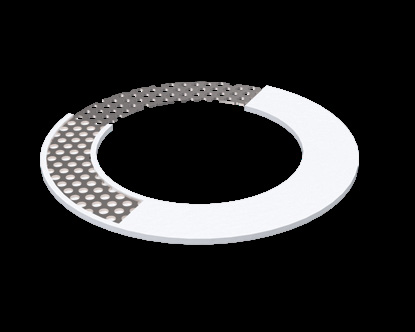
Envelope and solid PTFE gaskets, NB 1/2" to 16"
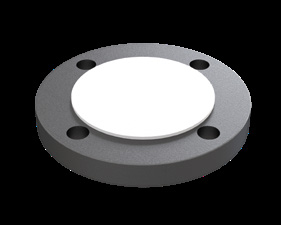
PTFE envelope gaskets with a metallic or non-metallic insert, and plain solid PTFE gaskets — NB 1/2" to 16", for joints between lined and dissimilar components.
| Product type | PTFE envelope gasket / plain PTFE gasket |
|---|---|
| Lining material | PTFE |
| Liner standard | ASTM D 1457 |
| Lining options | Virgin or anti-static (conductive black) PTFE to ASTM D 4894 & D 4895, PFA to ASTM D 3307, FEP to ASTM D 2116 |
| Flange standard | To suit ASME/ANSI B16.5 flanges |
| Size range | NB 1/2" to NB 16" |
| Temperature range | Continuous service to 260 °C (PTFE melting point 327 °C, PFA 306 °C, FEP 260 °C) |
| Pressure rating | ASME/ANSI B16.5 Class 150 flanges as standard; Class 300 available on request |
Product overview
Lined components bolted to each other generally seal liner-face to liner-face and need no gasket. A gasket becomes necessary in two cases the catalogue names specifically: when a lined component is joined to a different material, and where a joint is repeatedly assembled and dismantled.
Two forms are offered. The envelope gasket wraps a PTFE jacket around an insert — metallic or non-metallic — which gives the compressive strength and recovery of the insert with the chemical inertness of PTFE on every wetted surface. The plain PTFE gasket is a solid fluoropolymer ring for lighter duty.
Both are listed NB 1/2" to 16" with the liner to ASTM D 1457. Higher dimensions are available on request.
Features
Benefits
Applications & industries
Technical data
Figures below are for this product only — every item in the range carries its own dimension table.
| Product type | PTFE envelope gasket / plain PTFE gasket |
|---|---|
| Lining material | PTFE |
| Liner standard | ASTM D 1457 |
| Lining options | Virgin or anti-static (conductive black) PTFE to ASTM D 4894 & D 4895, PFA to ASTM D 3307, FEP to ASTM D 2116 |
| Flange standard | To suit ASME/ANSI B16.5 flanges |
| Size range | NB 1/2" to NB 16" |
| Temperature range | Continuous service to 260 °C (PTFE melting point 327 °C, PFA 306 °C, FEP 260 °C) |
| Pressure rating | ASME/ANSI B16.5 Class 150 flanges as standard; Class 300 available on request |
| Manufacturing standard | ASTM F 1545 |
| Spark testing | Every lined component spark tested at 5000 × E volts (E = liner thickness in mm), to a maximum of 15 000 V |
| Hydro testing | Hydrostatic or pneumatic test according to the lining technique; hydrostatic test on components with vent holes |
| Inspection | Dimensional and visual examination of liner and steel parts — weld aspect, overall dimensions, collar size, liner thickness, surface flaws and paint thickness |
| Certification | EN 10204 3.1 mill certificates and FDA certification for the fluoropolymer available on request |
| Standard version | Metallic inserted gasket |
| Insert | Metallic or non-metallic |
| Parameter | Envelope gasket | PTFE gasket |
|---|---|---|
| Size range | NB 1/2" to NB 16" | NB 1/2" to NB 16" |
| Standard version | Metallic inserted gasket | Solid PTFE |
| Insert material | Metallic or non-metallic | None |
| Liner / material | PTFE to ASTM D 1457 | PTFE to ASTM D 1457 |
| Dimensions | ØOD, ØID and thickness H to suit the flange | ØOD, ØID and thickness H to suit the flange |
| Available on request | Higher dimensions | Higher dimensions |
The catalogue gives this item by outer diameter, inner diameter and thickness against the mating flange rather than as a fixed size table. Confirm the flange standard and drilling with your enquiry.
FAQ
Generally no — the flared liner faces seal against each other. A gasket is required when a lined component is joined to a different material, and where the joint is repeatedly assembled and dismantled.
The envelope form carries an insert that gives compressive strength and recovery, so it holds up better under bolt load and thermal cycling. A plain PTFE gasket suits lighter duty.
Related products
Enquiry
Send the bore, the media, the temperature and pressure, and the flange standard you work to. Drawings and custom sizes welcome.
Send your requirement — media, temperature, pressure, dimensions — and we'll recommend the right product or fabricate it.
Talk to an engineer