Jacketed Pipe Section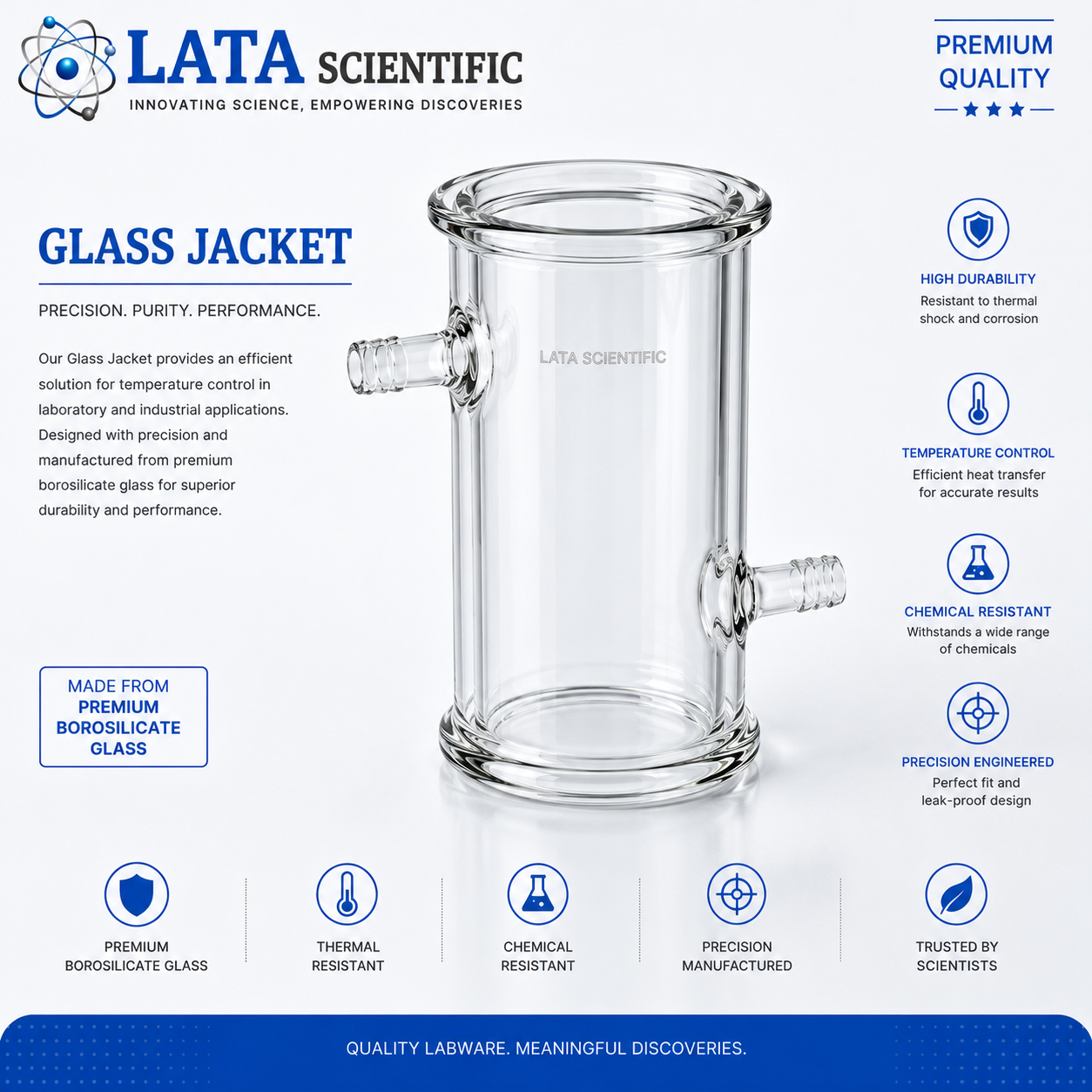
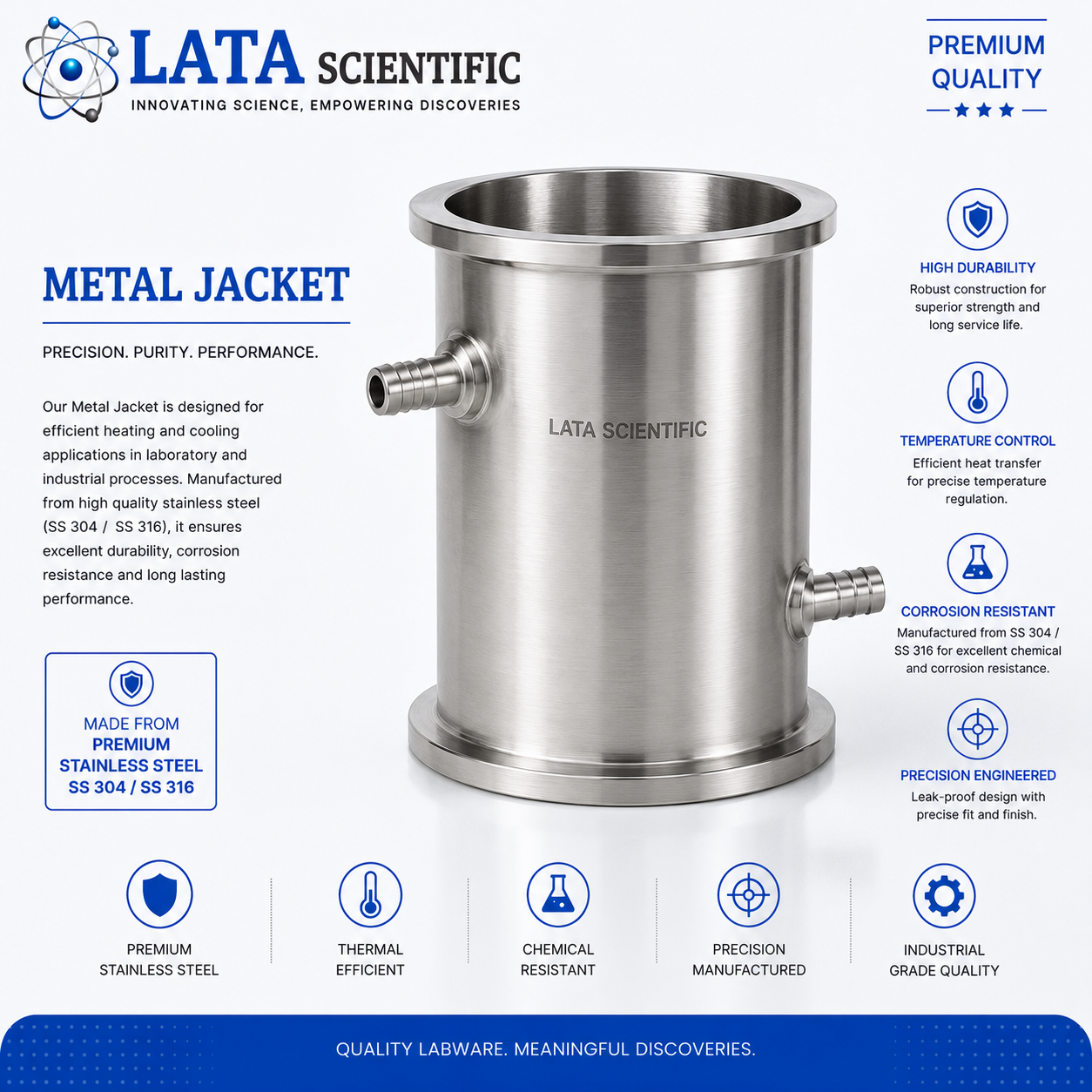
Metal jacketed pipe section, DN 80 to DN 300
Metal jacketed pipe section for heating a glass line where visibility through the jacket is not required — DN 80 to DN 300, 1000 mm long.
| Product type | Metal jacketed pipe section |
|---|---|
| Material | Borosilicate 3.3 |
| Nominal bore range | DN 80 to DN 300 |
| End connection | Beaded pipe ends with backing flanges and PTFE-envelope gaskets |
| Flange drilling | See the drilling table — BS 10 Table E, BS 10 Table F and ASA drilling available |
| Pressure rating | Not published on the metal jacket datasheet — confirm the service pressure with us |
| Temperature rating | Not published on the component datasheet — confirm with us for your duty |
| Dimensional standard | As per the Lata Scientific component datasheet |
Product overview
The metal jacket does the same job as the glass jacket — circulating a heating or cooling service around the pipe section — in a more robust and more compact form. At every bore its outside dimension d is smaller than the glass equivalent, which matters where jacketed sections run close together.
The trade-off is visibility: you can no longer see the product through the jacketed length. Where that matters, use the glass jacket.
Features
Benefits
Applications & industries
Technical data
Figures below are for this product only — every item in the range carries its own dimension table.
| Product type | Metal jacketed pipe section |
|---|---|
| Material | Borosilicate 3.3 |
| Nominal bore range | DN 80 to DN 300 |
| End connection | Beaded pipe ends with backing flanges and PTFE-envelope gaskets |
| Flange drilling | See the drilling table — BS 10 Table E, BS 10 Table F and ASA drilling available |
| Pressure rating | Not published on the metal jacket datasheet — confirm the service pressure with us |
| Temperature rating | Not published on the component datasheet — confirm with us for your duty |
| Dimensional standard | As per the Lata Scientific component datasheet |
| Catalogue reference | LSPSJ series, e.g. LSPSJ6/1000 = DN 150 × 1000 mm |
| Standard length | 1000 mm |
| Service connection | DN 25 |
| Cat. Ref. | DN | L | d | DN1 | J | J1 |
|---|---|---|---|---|---|---|
| LSPSJ3/1000 | 80 | 1000 | 100 | 25 | 850 | 750 |
| LSPSJ4/1000 | 100 | 1000 | 135 | 25 | 850 | 750 |
| LSPSJ6/1000 | 150 | 1000 | 188 | 25 | 850 | 700 |
| LSPSJ9/1000 | 225 | 1000 | 262 | 25 | 850 | 700 |
| LSPSJ12/1000 | 300 | 1000 | 345 | 25 | 850 | 650 |
All dimensions in mm, transcribed exactly from the component datasheet. Compare d against the glass jacket: the metal jacket is smaller at every bore from DN 100 upward.
FAQ
The metal jacket datasheet publishes no pressure figure, so none is quoted here. Send us the service medium, pressure and temperature and we will confirm the design.
Yes. The jacket is metal; the pipe section inside it is borosilicate 3.3, so the product still only touches glass.
Related products
Enquiry
Send the bore, the media, the temperature and pressure, and the flange standard you work to. Drawings and custom sizes welcome.
Send your requirement — media, temperature, pressure, dimensions — and we'll recommend the right product or fabricate it.
Talk to an engineer