Coil Boilers & Product Coolers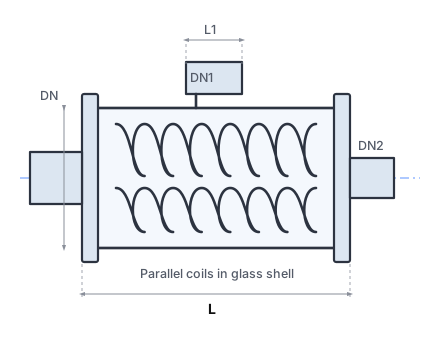
Coil condenser in borosilicate glass
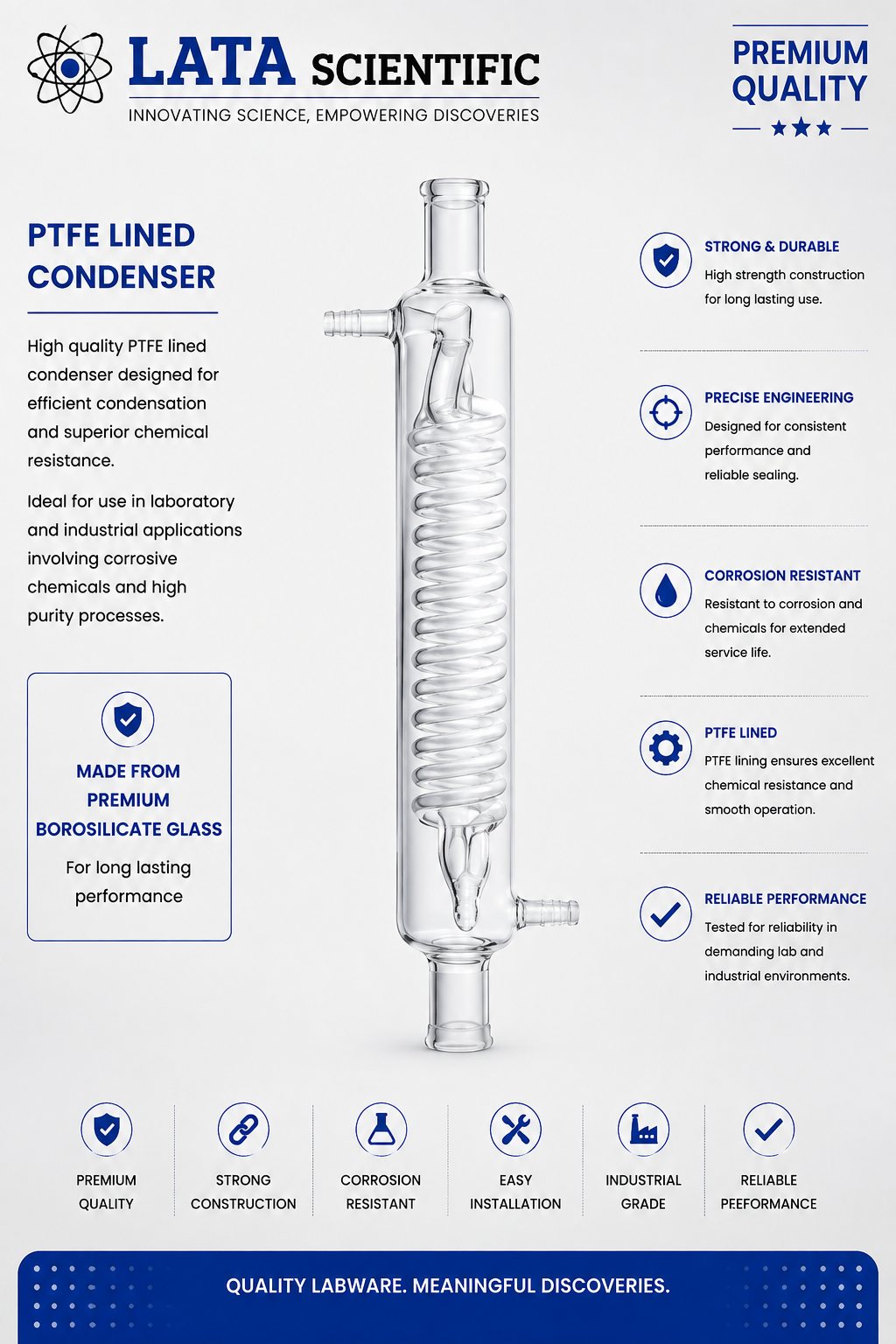
Coil condenser in borosilicate glass for efficient condensation of vapour — the cooling medium runs through the coil while vapour condenses around it in the shell, and the whole process stays visible.
| Product type | Coil condenser in glass shell |
|---|---|
| Material | Borosilicate 3.3 |
| Lining | PTFE lined, as stated on the supplied product sheet |
| Construction | Coil fused in a glass shell with side connections |
| Cooling medium | Circulated through the coil |
| Shell size range | No datasheet supplied for this item — confirmed on enquiry |
| Heat transfer area | No datasheet supplied for this item — confirmed on enquiry |
| Catalogue reference | Confirmed on enquiry |
Product overview
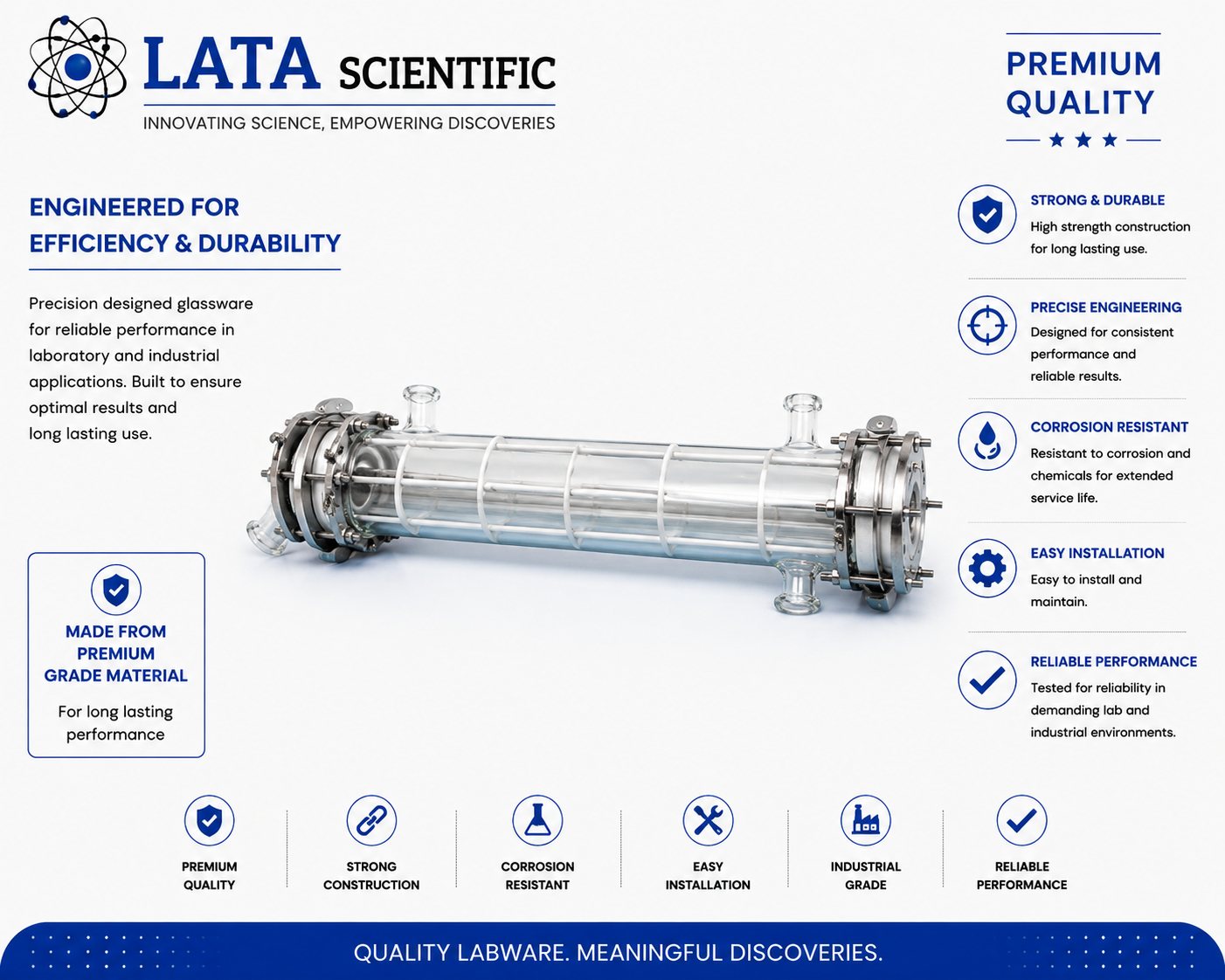
The condenser is the counterpart to the boiler in a glass distillation train. A coil is fused into a glass shell; cooling water circulates through the coil, and vapour entering the shell gives up its latent heat to the coil surface and runs off as condensate. Because both the shell and the coil are borosilicate, the operator can watch the condensation front and check that the unit is not flooding or letting vapour through.
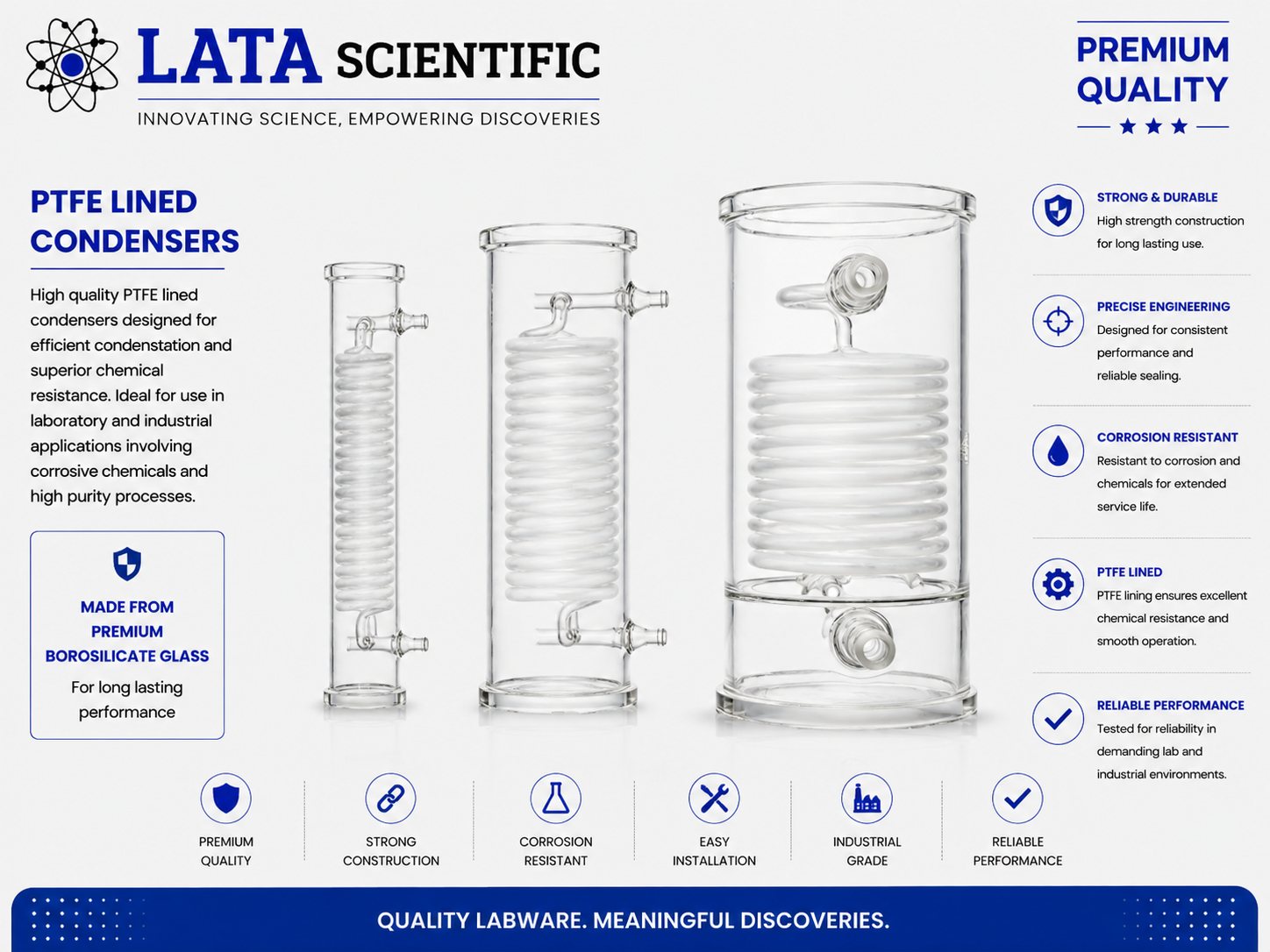
The supplied product sheet describes it as a PTFE lined condenser built from premium borosilicate glass, for efficient condensation and superior chemical resistance — intended for laboratory and industrial duty on corrosive chemicals and high purity processes. The sheet shows the unit in three body sizes, from a slim column-mounted condenser to a wide-bodied unit with flanged connections.
No dimensional datasheet was supplied for this item, so its shell sizes, coil heat transfer areas and catalogue references are confirmed on enquiry rather than estimated from the neighbouring boiler and product cooler pages.
Features
Benefits
Applications & industries
Technical data
Figures below are for this product only — every item in the range carries its own dimension table.
| Product type | Coil condenser in glass shell |
|---|---|
| Material | Borosilicate 3.3 |
| Lining | PTFE lined, as stated on the supplied product sheet |
| Construction | Coil fused in a glass shell with side connections |
| Cooling medium | Circulated through the coil |
| Shell size range | No datasheet supplied for this item — confirmed on enquiry |
| Heat transfer area | No datasheet supplied for this item — confirmed on enquiry |
| Catalogue reference | Confirmed on enquiry |
FAQ
The supplied product sheet shows three body sizes but publishes no dimensions, so we do not quote a shell size or heat transfer area here. Send us your vapour load and cooling water temperature and we will confirm the right unit against the drawing.
Duty and shell cross section. The boiler vapourises liquid by passing steam through the coil and is built with a bigger shell-side cross section to carry vapour away. The condenser does the opposite — cooling medium in the coil, vapour condensing in the shell.
Yes. The wetted path is borosilicate glass with PTFE lining, which is why the product sheet calls it out for corrosive chemicals and high purity processes.
Not for this item. The boiler page publishes 350 Kcal/m²hr·°C at 3.5 bar steam because that figure is printed in its catalogue page; no equivalent figure was supplied for the condenser, so none is claimed.
Related products
Enquiry
Send the bore, the media, the temperature and pressure, and the flange standard you work to. Drawings and custom sizes welcome.
Send your requirement — media, temperature, pressure, dimensions — and we'll recommend the right product or fabricate it.
Talk to an engineer