Coil Boilers & Product Coolers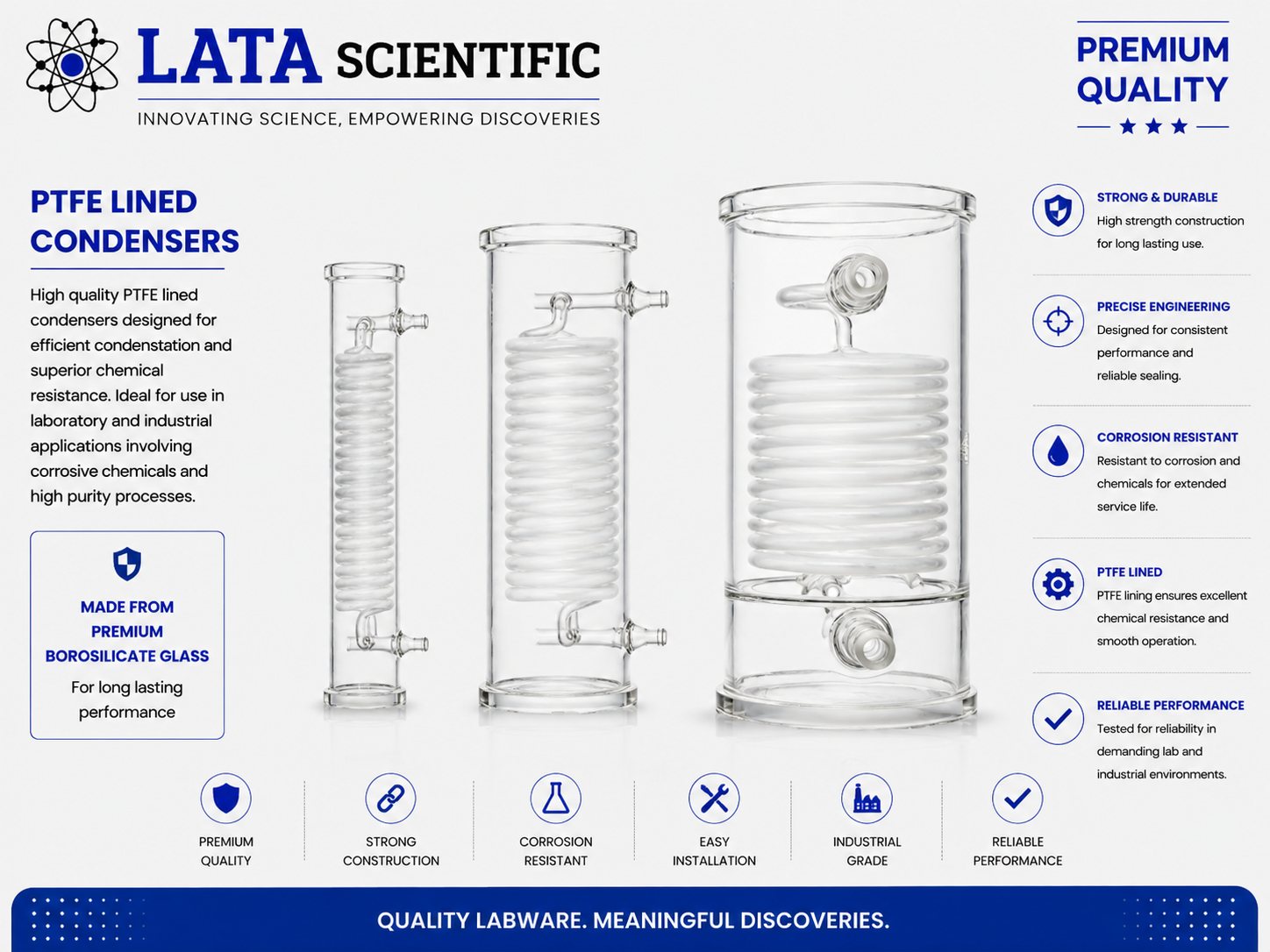
LSHEB series, 0.15 m² to 1.30 m²
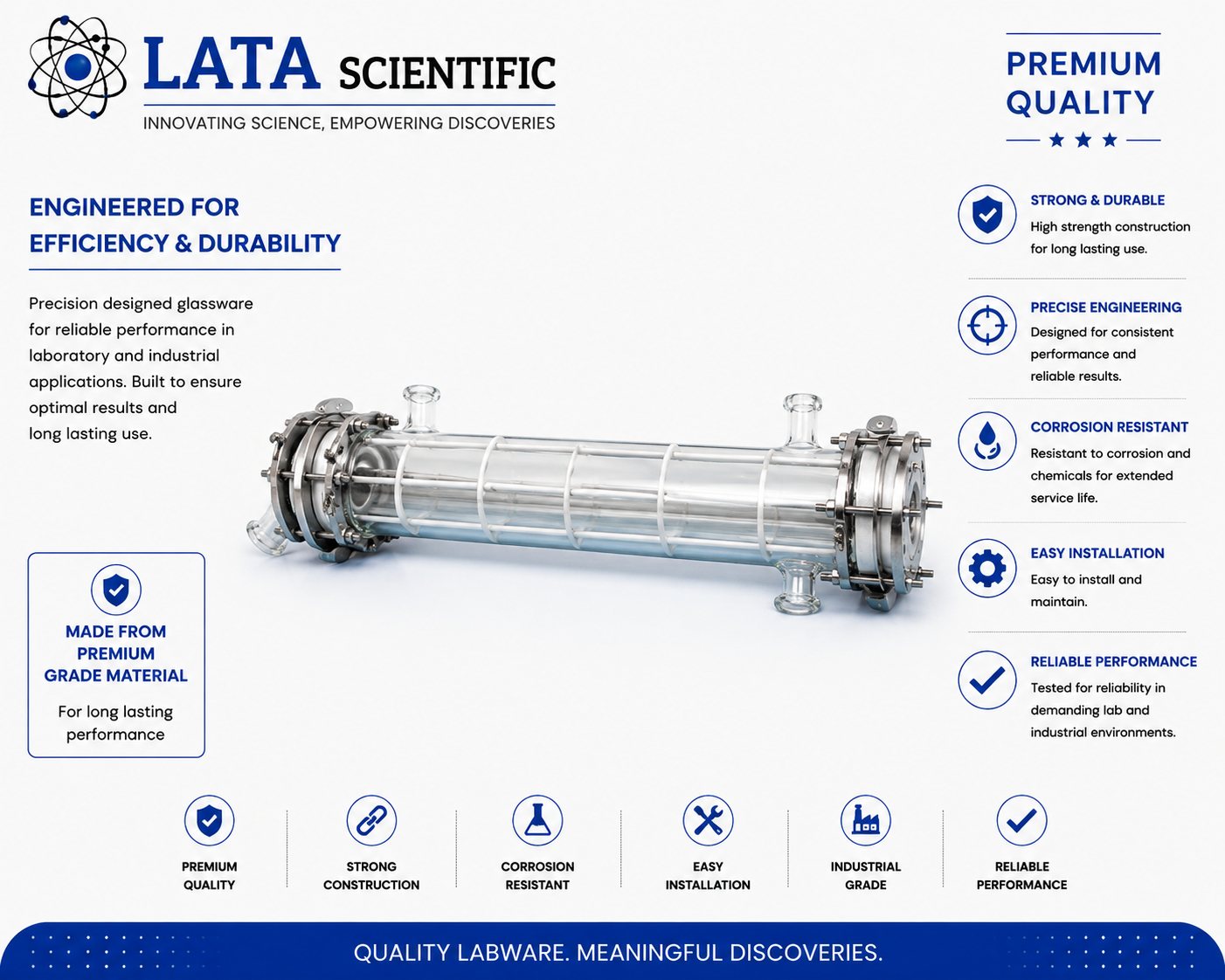
Coil boiler for vapourising liquids with steam — parallel coils fused into a glass shell, sized on a 350 Kcal/m²hr·°C average heat transfer at 3.5 bar steam.
| Product type | Coil boiler (vapouriser) in glass shell |
|---|---|
| Construction | Number of parallel coils fused in a glass shell |
| Heating medium | Steam through the coil |
| Maximum steam pressure | 3.5 bar, equivalent to 147 °C |
| Average heat transfer | 350 Kcal/m²hr·°C at 3.5 bar steam pressure |
| Free actual H.T.A. | 0.15 m² to 1.30 m² |
| Shell size range | DN 100 to DN 300 |
| Cross area | 40 cm² to 330 cm² |
Product overview
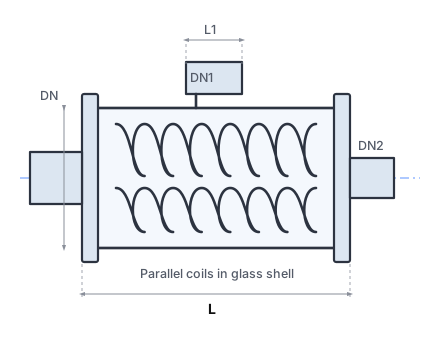
The boiler is used for vapourisation of liquids by passing steam in the coil. It is made by fusing a number of parallel coils in a glass shell, so the heating surface sits directly in the liquid being boiled and the whole process stays visible.
In the boiler, coils are designed to provide a bigger cross section on the shell side as compared to a condenser. That matters because the shell side has to carry vapour away as it is generated — too small a cross section and the boiler chokes on its own product.
The average heat transfer in a boiler is considered as 350 Kcal/m²hr·°C at a steam pressure of 3.5 bar. The catalogue's note on use is specific: steam should be passed in the coil at a maximum pressure of 3.5 bar, which is equivalent to a temperature of 147 °C.
Features
Benefits
Applications & industries
Technical data
Figures below are for this product only — every item in the range carries its own dimension table.
| Product type | Coil boiler (vapouriser) in glass shell |
|---|---|
| Construction | Number of parallel coils fused in a glass shell |
| Heating medium | Steam through the coil |
| Maximum steam pressure | 3.5 bar, equivalent to 147 °C |
| Average heat transfer | 350 Kcal/m²hr·°C at 3.5 bar steam pressure |
| Free actual H.T.A. | 0.15 m² to 1.30 m² |
| Shell size range | DN 100 to DN 300 |
| Cross area | 40 cm² to 330 cm² |
| Jacket capacity | 2 to 40 litres |
| Catalogue reference | LSHEB series |
| Cat. Ref. | DN | DN1 | DN2 | L | L1 | Type | Free actual H.T.A. (m²) | Cross area (cm²) | Jacket cap. (litre) |
|---|---|---|---|---|---|---|---|---|---|
| LSHEB4 | 100 | 25 | 25 | 375 | 100 | A | 0.15 | 40 | 2 |
| LSHEB4/4 | 100 | 100 | 25 | 400 | 100 | B | 0.15 | 40 | 3 |
| LSHEB6 | 150 | 40 | 25 | 450 | 100 | A | 0.35 | 50 | 5 |
| LSHEB6/6 | 150 | 150 | 25 | 500 | 100 | B | 0.35 | 50 | 7 |
| LSHEB9 | 225 | 40 | 25 | 700 | 100 | A | 1.00 | 150 | 16 |
| LSHEB9/9 | 225 | 225 | 25 | 700 | 100 | B | 1.00 | 180 | 20 |
| LSHEB12/12 | 300 | 300 | 25 | 700 | 125 | B | 1.30 | 330 | 40 |
All dimensions in mm, transcribed from the catalogue page and transposed to one row per model. Type A carries a reduced DN1 side connection; Type B carries a full-bore DN1 equal to the shell. Heat transfer area is the free actual figure printed in the catalogue.
FAQ
3.5 bar maximum, which the catalogue notes is equivalent to a temperature of 147 °C. The published heat transfer figure of 350 Kcal/m²hr·°C is quoted at that same pressure.
Because a boiler has to carry vapour away from the shell side as fast as it is generated. The catalogue states the coils are designed to provide a bigger cross section in the shell side compared to a condenser for exactly this reason.
The DN1 connection. Type A has a reduced side connection — 25 mm on LSHEB4, 40 mm on LSHEB6 and LSHEB9. Type B has a full-bore DN1 equal to the shell, which suits a higher vapour load.
On duty. Take the average heat transfer as 350 Kcal/m²hr·°C at 3.5 bar steam, and pick the free actual H.T.A. that meets it — 0.15 m² at the smallest to 1.30 m² on LSHEB12/12. Send us the vapourisation rate and we will confirm.
Related products
Enquiry
Send the bore, the media, the temperature and pressure, and the flange standard you work to. Drawings and custom sizes welcome.
Send your requirement — media, temperature, pressure, dimensions — and we'll recommend the right product or fabricate it.
Talk to an engineer