Dip Pipes & Dip Legs
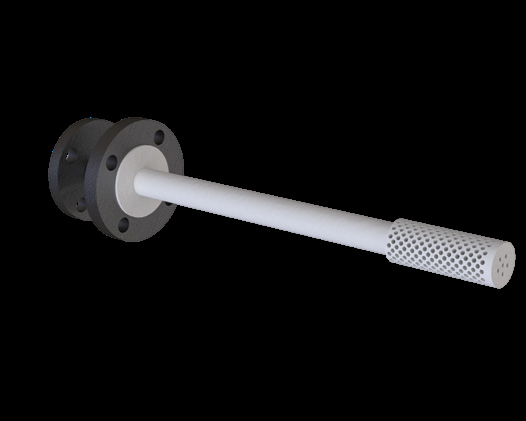
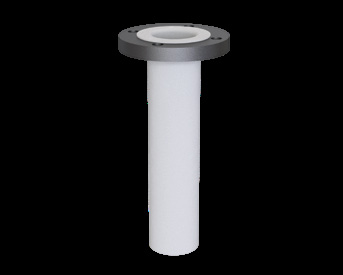
Lined dip pipe with drilled sparger, made to your requirement
Lined dip pipe ending in a drilled sparger that breaks gas into fine bubbles across the vessel — dimensions, hole pattern and length made entirely to your requirement.
| Product type | Lined dip pipe with drilled sparger |
|---|---|
| Body / steel grade | ASTM A 106 Gr. B pipe, IS 2062 plate / ASTM A 105 flanges |
| Lining material | PTFE |
| Liner standard | ASTM D 1457 / ASTM D 4894-19 |
| Lining options | Virgin or anti-static (conductive black) PTFE to ASTM D 4894 & D 4895, PFA to ASTM D 3307, FEP to ASTM D 2116 |
| Flange standard | ASME/ANSI B16.5 |
| Flange class | Class 150 standard; Class 300 on request |
| Size range | NB 1/2" to NB 8" |
Product overview
A sparger disperses gas into a liquid batch as many small bubbles instead of one large stream. That multiplies the gas–liquid interface area, which is what drives mass transfer in hydrogenation, oxidation, chlorination and stripping duties. A plain open dip pipe delivers a single coarse stream and transfers a fraction as much.
Because hole size, hole count, pitch and sparger geometry all depend on the gas rate, the bubble size wanted and the vessel dimensions, the catalogue publishes no standard dimension table for this item — it is made to the customer's requirement. Send the vessel arrangement, the gas and its flow rate, and the batch details.
Construction follows the dip pipe range: ASTM A 106 Gr. B body, IS 2062 or ASTM A 105 flanges, PTFE liner to ASTM D 1457.
Features
Benefits
Applications & industries
Technical data
Figures below are for this product only — every item in the range carries its own dimension table.
| Product type | Lined dip pipe with drilled sparger |
|---|---|
| Body / steel grade | ASTM A 106 Gr. B pipe, IS 2062 plate / ASTM A 105 flanges |
| Lining material | PTFE |
| Liner standard | ASTM D 1457 / ASTM D 4894-19 |
| Lining options | Virgin or anti-static (conductive black) PTFE to ASTM D 4894 & D 4895, PFA to ASTM D 3307, FEP to ASTM D 2116 |
| Flange standard | ASME/ANSI B16.5 |
| Flange class | Class 150 standard; Class 300 on request |
| Size range | NB 1/2" to NB 8" |
| Temperature range | Continuous service to 260 °C (PTFE melting point 327 °C, PFA 306 °C, FEP 260 °C) |
| Pressure rating | ASME/ANSI B16.5 Class 150 flanges as standard; Class 300 available on request |
| Manufacturing standard | ASTM F 1545 |
| Spark testing | Every lined component spark tested at 5000 × E volts (E = liner thickness in mm), to a maximum of 15 000 V |
| Hydro testing | Hydrostatic or pneumatic test according to the lining technique; hydrostatic test on components with vent holes |
| Inspection | Dimensional and visual examination of liner and steel parts — weld aspect, overall dimensions, collar size, liner thickness, surface flaws and paint thickness |
| Vent holes | 3 mm diameter vent holes — one per fitting; spools under 500 mm get a single central hole, spools over 500 mm get two holes about 150 mm from each end |
| External protection | Zinc epoxy primer, minimum 60 μm dry film, over steel sand-blasted to SA 2.5 |
| Certification | EN 10204 3.1 mill certificates and FDA certification for the fluoropolymer available on request |
| Standard version | Straight dip pipe with sparger |
| Dimensional table | As per customer's requirement |
| Parameter | Value |
|---|---|
| Size range | NB 1/2" to NB 8" |
| Flange standard | ASME/ANSI B16.5 Class 150 |
| Body | Carbon steel, ASTM A 106 Gr. B |
| Liner | PTFE to ASTM D 1457 |
| Sparger hole size, count and pitch | As per customer's requirement |
| Overall length and immersion depth | As per customer's requirement |
The catalogue lists this item as “Dimensional Table — As per Customers' Requirement”. No standard hole pattern or length is published, so none has been assumed here.
FAQ
The gas and its flow rate, the operating pressure and temperature, the liquid and its level, the vessel diameter and the nozzle you are mounting on. Bubble size and hole pattern follow from those.
Sparger geometry is duty-specific — the same NB 2" dip pipe may need very different hole patterns for air sparging and for hydrogenation. The catalogue therefore builds each one to requirement.
Related products
Enquiry
Send the bore, the media, the temperature and pressure, and the flange standard you work to. Drawings and custom sizes welcome.
Send your requirement — media, temperature, pressure, dimensions — and we'll recommend the right product or fabricate it.
Talk to an engineer